
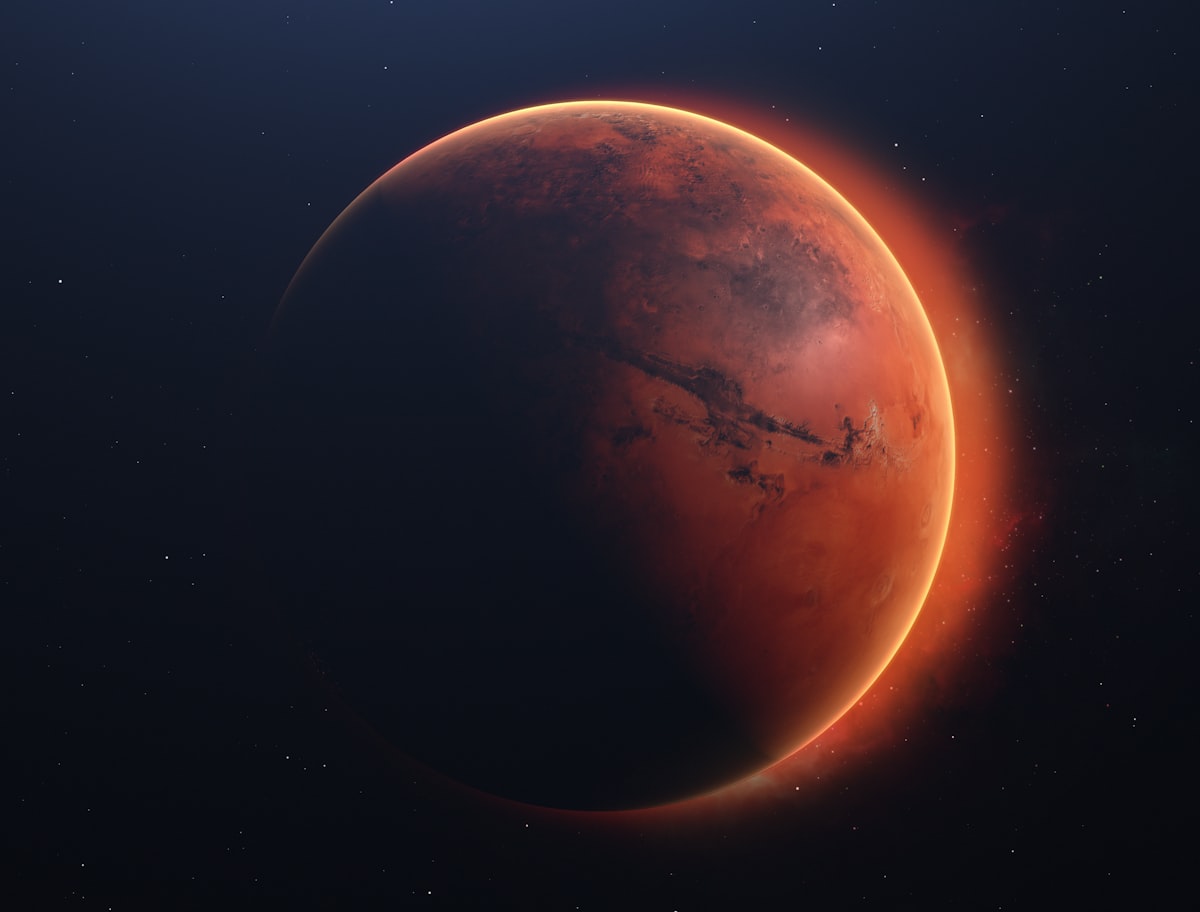
On May 15, a refrigerator-sized spacecraft built mostly of aluminum and solar panels passed 2,864 miles above the surface of Mars, traded a small piece of the planet’s orbital energy for a small piece of its own, and came out the far side a thousand miles an hour faster. NASA’s Psyche mission did not stop, did not slow, and did not photograph anything by accident. The flyby was a precisely planned ricochet, and the spacecraft is now on a long, lazy arc toward an object 173 miles across that may be the exposed metallic core of a world that never quite finished forming.
What actually happened on May 15
Gravity assists look magical and are not. A spacecraft passes close to a planet, falls into its gravity well, and falls back out the other side. Energy and momentum are conserved between the two bodies, so the planet loses a vanishingly tiny amount of its orbital motion and the spacecraft gains an enormous amount of its own. The trick is that the spacecraft’s “small amount” is, in absolute terms, much bigger than the planet’s “large amount,” because mass ratios.
For Psyche, the numbers came out clean. Don Han, the mission’s navigation lead, confirmed afterward that “Mars gave the spacecraft a 1,000 mile-per-hour boost and shifted its orbital plane by about 1 degree.” The plane change matters as much as the speed. The asteroid Psyche orbits the Sun on a path tilted slightly relative to most of the inner solar system, and the only way to meet it cheaply is to bend Psyche’s trajectory into something closer to its target’s. One degree, gifted by Mars at no fuel cost, is a degree Psyche does not have to buy with its ion engines later.
Closest approach was 4,609 kilometers above the Martian surface. For comparison, the International Space Station orbits Earth at about 400 kilometers. Psyche was eleven times farther from Mars than the station is from us, but on the scale of the solar system that is essentially scraping the paint.
Mars as a free instrument test
Mars is not the mission. The asteroid is the mission. But you do not pass a planet at close range without turning the cameras on.
Psyche’s operations team powered up the spacecraft’s multispectral imager, its twin magnetometers, and its gamma-ray and neutron spectrometer during the encounter. Each instrument has a real job to do at the asteroid three years from now, and each one needed to be calibrated against a known target. Mars is extremely well known. We have orbiters, landers, rovers, decades of spectra, and detailed magnetic and gravity maps. Pointing a fresh instrument at Mars is the closest thing planetary science has to a standardized eye chart.
The imager returned thousands of frames during approach. Some of the most striking show Mars as a thin crescent, sunlit on one edge and dark on the other, with the polar ice cap catching light at high latitudes. Crescent views of Mars are rare from Earth-based observatories because we never see the planet from the right angle. They are common from spacecraft, and they always look slightly unreal.
The magnetometers may have done something more interesting. Mars has no global magnetic field anymore, but the solar wind hits its upper atmosphere and creates an induced magnetosphere with a bow shock standing in front of the planet. Psyche’s flight path was set up to slice through that region, and early indications from the magnetometer data suggest a detection. The science team is still working through it. If the bow shock crossing is confirmed, it is a clean cross-check that Psyche’s instruments will see real magnetic structures, not noise, when they reach the asteroid.
Why the asteroid is worth all of this
The destination is a body called 16 Psyche. It is one of the largest objects in the main asteroid belt, about 173 miles across at its widest, lumpy, and unusually dense. Radar and thermal observations from Earth suggest a surface dominated by iron and nickel, more like the inside of a planet than the outside.
That is the hypothesis that makes the mission worth a billion dollars. Every rocky planet in the inner solar system, including Earth, has a metal core. We have never seen one directly, because they are buried under thousands of miles of rock, and because we cannot drill through the mantle. If Psyche is what some researchers think it is, a stripped planetesimal whose rocky outer layers were knocked away by ancient collisions, then orbiting it is the closest humans will ever come to flying over the inside of a planet.
The “if” is large. Psyche might instead be a primitive body that simply formed with an unusual composition, never differentiated, never had a rocky shell to lose. That would be its own kind of interesting and would force a rethink of how the early solar system distributed metals. There is no losing version of this mission, scientifically. There is only the version where the prior beliefs survive and the version where they do not.
The rest of the trip
Psyche launched in October 2023, threaded a Mars flyby in May 2026, and is scheduled to enter orbit around its target asteroid in August 2029. The arrival is propulsion-light by design. Most of the cruise will be handled by four Hall-effect thrusters, the same kind of low-thrust ion engine that flew on Dawn a decade earlier. Hall thrusters give a tiny push (about as hard as a sheet of paper pressing on your hand) but they give it continuously, for months at a time. Over the full mission, Psyche’s engines will fire for the equivalent of years.
Once in orbit, the spacecraft will work its way down through a sequence of progressively lower circular orbits, mapping the surface in visible and near-infrared light, measuring magnetic field structure, and using neutron and gamma-ray emission to identify what the asteroid is actually made of. The lowest orbit, planned for about 65 kilometers above the surface, will give resolution good enough to see individual craters on something the size of Massachusetts.
For now, Psyche is past Mars, moving faster than it was a week ago, and very nearly silent. The next milestone is the one that matters. The ion engines will do most of the work between here and 2029, and most of what we will hear in the meantime is health-and-status telemetry, the kind of routine traffic that means everything is going right.
Mars was the rehearsal. The performance is still three summers away.
Learn more: NASA’s Psyche mission page, nasa.gov/missions/psyche-mission. Han’s flyby confirmation and gravity-assist parameters are from NASA’s May 22, 2026 release on the Mars flyby. Asteroid composition estimates draw on Elkins-Tanton et al., “Distinguishing the origin of asteroid (16) Psyche,” Space Science Reviews 216 (2020): 74.