
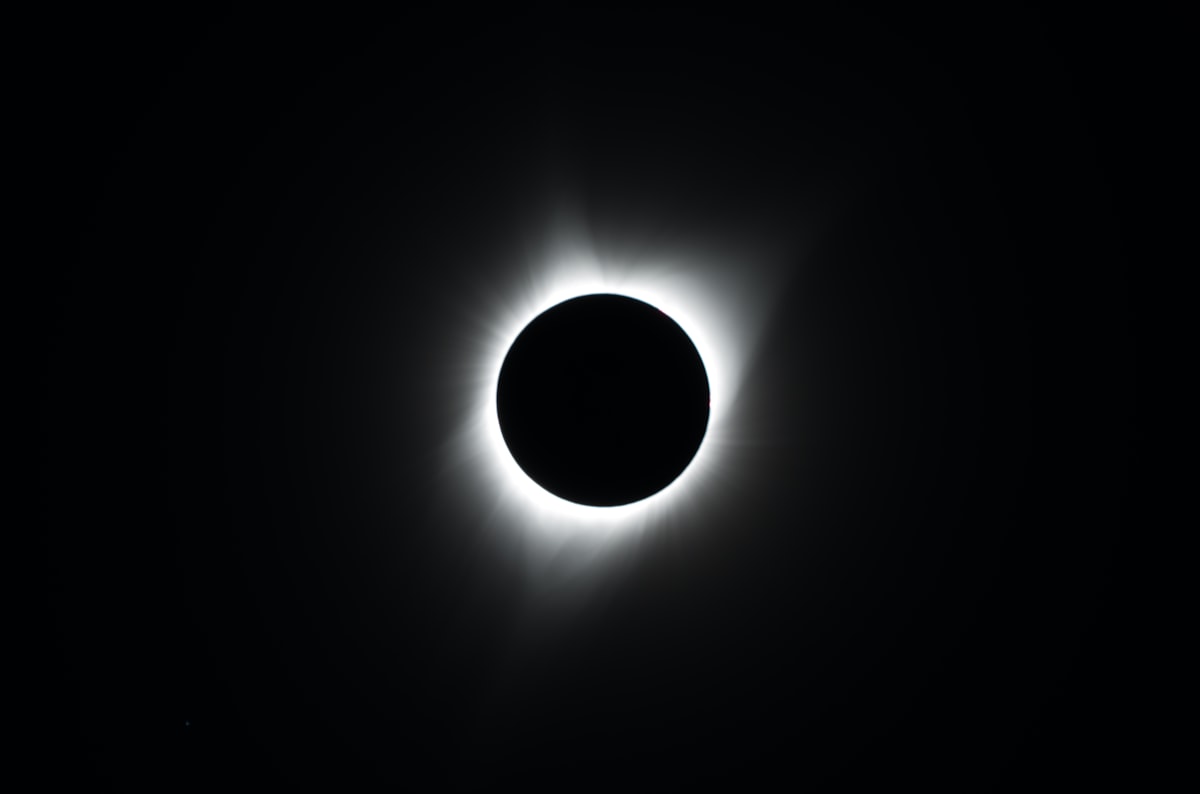
Exactly 107 years ago today, two British expeditions on opposite sides of the Atlantic photographed a patch of sky next to the eclipsed sun and produced a number that Isaac Newton’s physics could not. The starlight grazing the solar limb had been deflected by 1.75 arcseconds, twice the value Newtonian gravity allowed, and within the margin of Albert Einstein’s three-year-old general theory of relativity. The result was announced in London that November. By the next morning Einstein was the most famous scientist alive.
Why this eclipse was the test
Einstein had published the field equations of general relativity in 1915. The theory predicted that mass curves spacetime and that light, following the geometry of that curved spacetime, would be deflected as it passed a massive body. For a ray just skimming the surface of the sun, the predicted deflection was 1.75 arcseconds, about half a millionth of a degree. Newton’s gravity, applied naively to photons as if they were particles with mass, gave a prediction too: but only 0.87 arcseconds, exactly half. The two theories disagreed by a factor of two on the same observation. All anyone had to do was measure it.
Measuring stars next to the sun is normally impossible, because the sun is twelve magnitudes brighter than anything around it. A total solar eclipse is the one exception. For a few minutes the moon blocks the disk entirely and the stars in the same field of view become photographable. The 1919 eclipse was almost engineered for the test. Totality lasted nearly seven minutes, one of the longest of the 20th century, and the sun on that date was crossing the Hyades, a dense field of bright stars in Taurus. The geometry would never be this good again for decades.
Two expeditions, one answer
The Royal Astronomical Society sent two teams. Arthur Eddington, with Edwin Cottingham, sailed to the island of Príncipe off the west coast of Africa. Andrew Crommelin and Charles Davidson set up at Sobral in northeastern Brazil. Splitting the expedition was insurance against weather, and the insurance was needed. Príncipe was overcast for most of totality and Eddington’s team got useful exposures on only a few plates through breaks in the clouds. Sobral had cleaner skies but trouble with one of its telescopes, whose primary mirror warped in the heat and ruined the focus on the main set of images.
Despite the troubles, both sites had enough data to compare star positions during the eclipse against their normal positions in plates taken months later, when the same field was photographed at night. The shift was small, of order the diameter of a pinhead held at arm’s length, but it was there. Eddington’s Príncipe plates gave a deflection of about 1.61 arcseconds. The backup astrographic plates from Sobral gave about 1.98. Both bracketed Einstein’s 1.75 and excluded Newton’s 0.87 with room to spare.
November 6, 1919
The results were announced at a joint meeting of the Royal Society and the Royal Astronomical Society on November 6, 1919, with a portrait of Newton looking down from the wall behind the lectern. The Times of London ran the headline “Revolution in Science: New Theory of the Universe, Newtonian Ideas Overthrown.” The New York Times, a few days later, settled on “Lights All Askew in the Heavens.” Einstein, who had been a respected but obscure professor in Berlin a year earlier, became the first true global scientific celebrity. His face was on magazine covers within months.
The Eddington measurement has been refined many times since. Modern radio interferometry of quasars passing behind the sun confirms the 1.75 arcsecond figure to better than 0.02 percent, which is among the most precise agreements between any physical theory and any measurement. The Príncipe and Sobral plates themselves are not used as evidence anymore, since the photographic technique was at the edge of what could be measured. The point of 1919 was not the precision. It was that a theory built from pure geometry, with no fitted parameters and no patches, had predicted a specific number in a specific direction, and that number turned out to be right.
What it still means
A century later the practical applications are everywhere: GPS satellites would drift by kilometers per day without relativistic corrections; gravitational lensing surveys map dark matter using the same effect Eddington photographed; the LIGO detectors that pick up merging black holes are direct heirs to the same field equations. None of it would have been believed if a cloudy island and a hot Brazilian plain had not, on the same morning 107 years ago, produced an answer Newton’s universe was not allowed to give.