
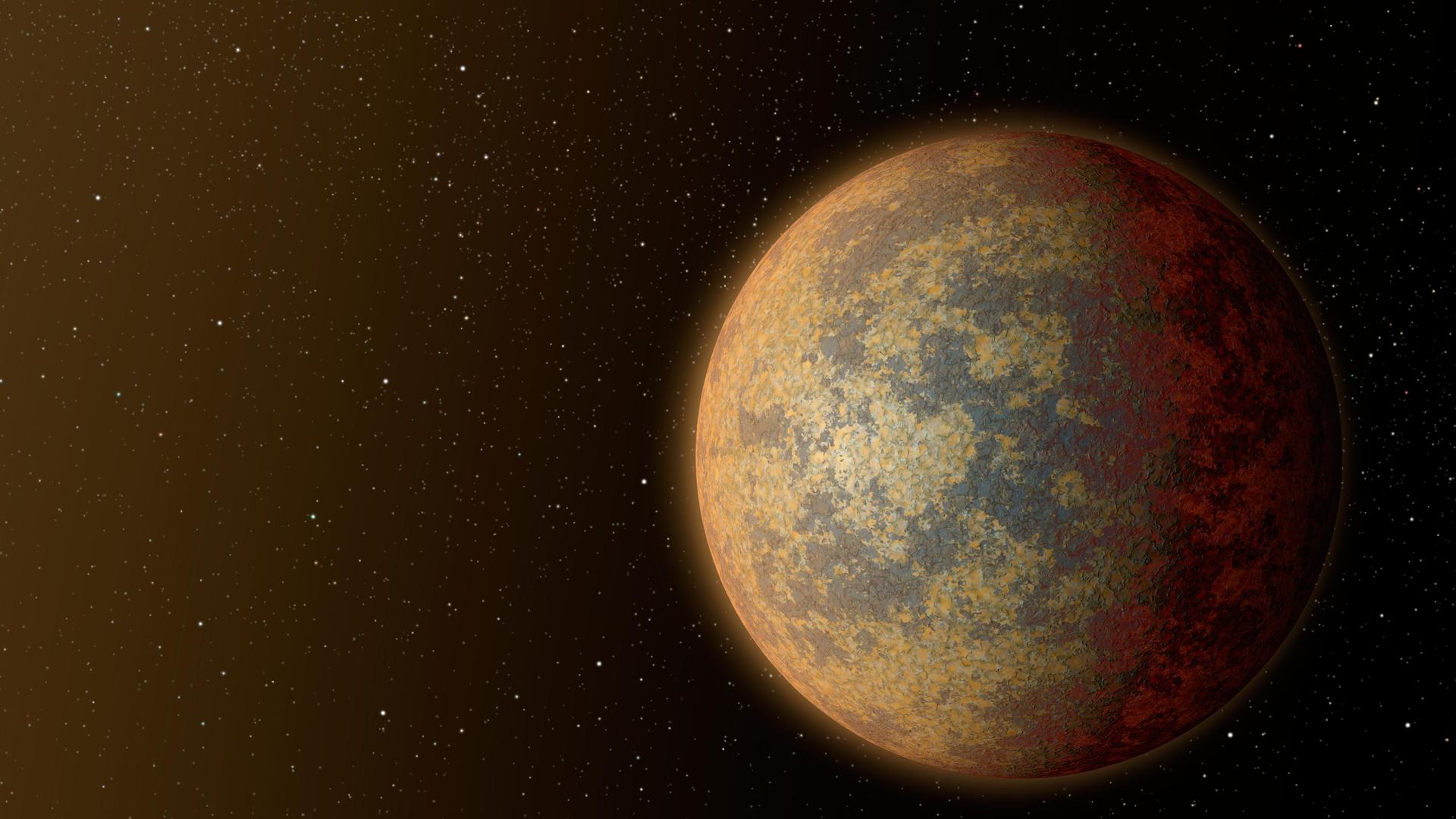
A team led by Sebastian Zieba at the Max Planck Institute for Astronomy has used the James Webb Space Telescope to do something no instrument had managed before: read the surface composition of a rocky planet orbiting another star. The target, LHS 3844 b, is a roughly Earth-sized world circling a red dwarf 48.5 light-years away. Webb’s mid-infrared spectrum, accepted by Nature Astronomy in April 2026, indicates the planet is a dark, airless ball of basalt-like rock. For exoplanet science, that is a milestone. For two decades, astronomers have read other worlds mostly through the gases sitting on top of them. This is the first time anyone has read the rock itself.
A planet pressed against its star
LHS 3844 b is a so-called super-Earth, about 30 percent wider than our planet. It orbits its small, cool host star once every 11 hours, sitting only three stellar diameters above the surface. Tidal forces have locked one face permanently toward the star. The dayside bakes; the nightside is starved of light.
Earlier work with the Spitzer Space Telescope hinted that the planet had little or no atmosphere. Webb has now confirmed and sharpened that picture using its MIRI instrument, taking a 5 to 12 micron thermal-emission spectrum. The shape of that spectrum, the way infrared light brightens and dims across wavelengths, is a fingerprint of what the dayside is made of and what gases, if any, are above it.
What the spectrum says
The team reports a featureless, dark surface best matched by basalt or other olivine-rich rock that has been weathered by stellar radiation and micrometeorite impacts. Fresh, powdery surfaces are ruled out. The data also place strict limits on any leftover atmosphere: at most 100 millibars of CO₂ at a 5-sigma confidence level, and no more than 10 microbars of SO₂ at 3-sigma. Both are tiny compared with Earth’s roughly 1,000 millibar atmosphere. There is, in effect, nothing there.
Two clean conclusions follow. First, the planet has not held on to a thick atmosphere, consistent with models that predict red dwarf stars strip atmospheres from close-in rocky planets early in their lives. Second, there is no sign of accumulated volcanic gas. Whatever geology shaped this crust, it is not throwing fresh sulfur into the air on observable timescales.
Why a bare rock matters
For a long time, “characterizing an exoplanet” has meant reading its atmosphere: the chemistry of light passing through a thin shell of gas during a transit. That technique has produced a remarkable picture of hot Jupiters, mini-Neptunes, and steam-shrouded sub-Neptunes. Rocky worlds have been harder. They are smaller and dimmer, and often their atmospheres turn out to be missing.
What Zieba and colleagues have demonstrated is that when the atmosphere is gone, Webb is sensitive enough to read the planet anyway. The shape of the rock’s thermal glow, in the right wavelengths, is enough to distinguish basalt from granite, fresh ash from weathered crust, hot lava from cold stone. That is the foundation for a new branch of the field: comparative exogeology, applied to planets too far away to visit.
What to watch next
LHS 3844 b is one of a small sample of nearby rocky worlds Webb is studying with similar techniques. Targets in the TRAPPIST-1 system and around stars like GJ 1132 are already being analyzed, and several teams are racing to confirm whether any of those planets do hold thin atmospheres. The bigger arc is the same one Carl Sagan would recognize: we are slowly building a catalog of other worlds with enough detail to ask, for each, whether it is more like Mercury, more like Venus, or more like home.
The first entry in the rock-by-rock chapter of that catalog reads: dark, basaltic, airless, weathered.
Sources: Nature Astronomy paper (Zieba et al. 2026); arXiv preprint 2605.00100; NASA JWST mission page; NASA MIRI instrument page.