
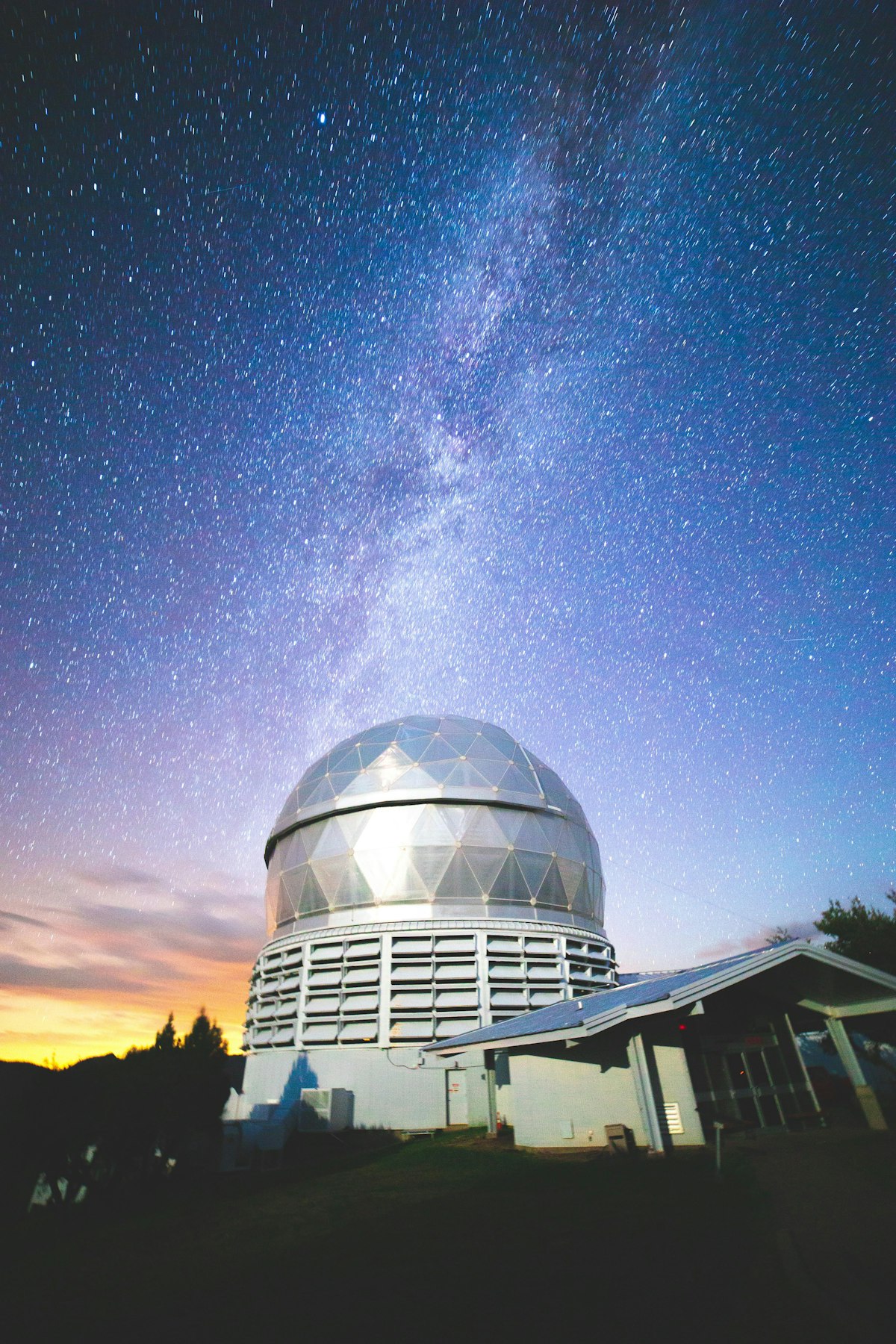
On the night of February 24, 2026, the Vera C. Rubin Observatory’s alert pipeline opened a tap and out came 800,000 transient detections in a single session. Each alert is a thing in the sky that changed: an asteroid moving through a field, a supernova flaring up, a variable star pulsing, a previously unknown object showing itself for the first time. Eight hundred thousand of them. From one telescope. In one night.
This is what astronomers have been promising and nervously planning for since the early 2000s. Rubin is now running.
The machine
The observatory sits on Cerro Pachón in northern Chile at about 2,700 meters of altitude. Its primary mirror is 8.4 meters across, which puts it in the same class as Gemini and the Very Large Telescope. What makes it different is the camera bolted to the back of it.
The LSST Camera is a 3.2 gigapixel CCD imager, the largest digital camera ever built. Its focal plane is roughly 64 centimeters across and packs 189 individual 4K-by-4K CCDs arranged into 21 modules called rafts. The whole assembly weighs 2,800 kilograms. The full sensor reads out in about two seconds. Each exposure covers a 9.6 square degree field, roughly 45 times the area of the full moon, in one shot.
The optical design is a three-mirror anastigmat, which means it can deliver sharp images across that entire wide field without the off-axis distortion that ordinary two-mirror telescopes suffer. It can also switch between six color filters, from near ultraviolet through to near infrared, which is how it builds the multicolor maps the survey depends on.
The survey
The actual program Rubin will run is called the Legacy Survey of Space and Time, or LSST. The plan is to point the telescope at every visible patch of southern sky every three to four nights, take a pair of 15-second exposures, then move on. Over ten years, the survey will accumulate about 800 visits to every part of its footprint. That gives astronomers a deep stacked image of the static sky, plus a continuous time-lapse movie of everything that moved or changed.
System first light came in June 2025. Engineering and commissioning ran through late 2025 and into early 2026. The full ten-year survey is beginning to ramp up now. February’s 800,000-alert night was the first time the real-time discovery pipeline ran end-to-end on a normal observing session.
What it is built to find
The expected catalog is hard to make intuitive because the numbers are absurd. Rubin is forecast to discover about 5 million new asteroids in the main belt, more than tripling the current catalog. It is expected to find roughly 100,000 new near-Earth objects, the population that matters most for planetary defense. It should catalog tens of thousands of new Kuiper Belt objects in the outer solar system. It is likely to find the largest sample of interstellar objects ever assembled, building on the two we have so far (1I/Oumuamua and 2I/Borisov).
In the extragalactic part of the program, the numbers go up by another order of magnitude. Rubin is projected to discover several million supernovae over the life of the survey, enough to use as cosmological distance markers in a way previous surveys could only do with hundreds. It will produce the deepest, widest map yet of weak gravitational lensing, the small distortions of background galaxies caused by intervening mass. That map is the single most powerful planned probe of dark matter and dark energy in the next decade.
The pipeline problem
The 800,000-alerts number is partly a tribute to the camera and partly a tribute to the software stack downstream of it. Each Rubin exposure generates about 6 gigabytes of raw data. Every image is differenced against a reference image of the same patch of sky, candidate sources are extracted, and each one is classified, packaged, and broadcast through a community alert system within about 60 seconds. Downstream brokers (ANTARES, ALeRCE, Fink, Lasair, and others) sort and filter the stream for specific science cases and send subsets to other telescopes for follow-up.
This is the part of modern astronomy that does not look like astronomy. It looks like an event-driven data architecture. The bottleneck for discovery is no longer collecting photons, it is sorting the firehose of detections fast enough that a follow-up telescope can be pointed at a fading supernova before it fades.
What is next
The next public data release, Data Preview 2, is scheduled for the July to September 2026 window. That release will let the broader community work with real LSST imagery rather than simulated data. The first formal annual data release, DR1, is expected about two years after the survey’s official start. The full ten-year survey runs into the mid-2030s.
The honest summary is that the Rubin era started this year, mostly quietly, behind a deluge of alerts most people will never see directly. The science it enables, from finding the next interstellar visitor to constraining dark energy, is now a matter of patience and software, not of waiting for the hardware to come online.