
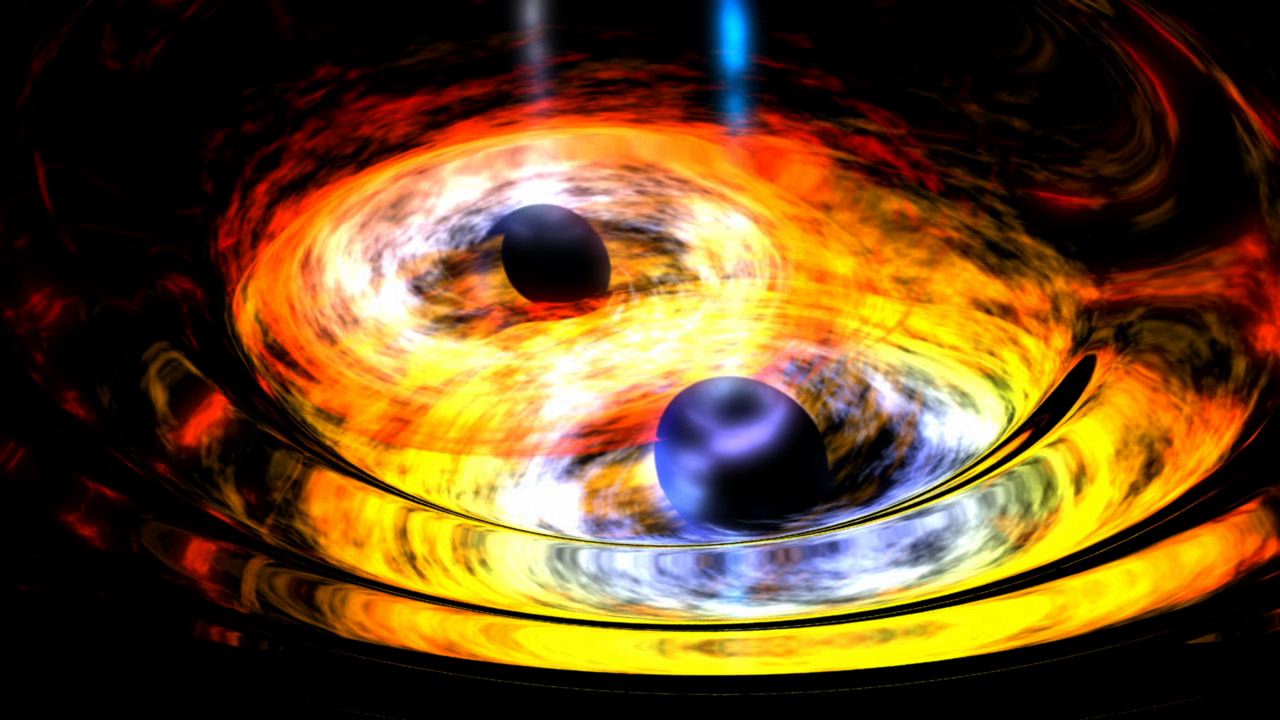
For decades stellar physicists have argued that there is a range of black-hole masses no dying star should ever produce. Roughly between 50 and 130 times the mass of the Sun, the cores of the most massive stars become so hot that pairs of electrons and positrons start popping out of the radiation itself. The new particles steal pressure from the core, the star contracts, and the result is a runaway thermonuclear blast that tears the entire stellar body apart with no compact remnant left behind. This is the pair-instability supernova, and it carves a forbidden zone into the black-hole population.
Two papers published in Nature this spring have now found that forbidden zone in real data.
What LIGO actually measured
The detectors at LIGO Hanford, LIGO Livingston, Virgo, and KAGRA spent their fourth observing run, O4, listening for the ripples in spacetime that arrive when two black holes spiral together and merge. By the time the fourth Gravitational-Wave Transient Catalog was assembled, the network had collected more than 200 confident black-hole merger events, enough for the first time to treat the population as a statistical distribution rather than a list of curiosities.
A team led by Hui Tong and Maya Fishbach mapped that distribution and found something cleaner than earlier runs had suggested. Sort each binary by the lighter of its two black holes, the secondary mass, and a sharp edge appears near 44 solar masses, with a 90 percent credible range of 40 to 49. Above that boundary, secondaries effectively vanish. A parallel analysis by Fabio Antonini and collaborators arrived at almost exactly the same number: 44.3 solar masses, plus 5.9, minus 3.5. Two independent teams, the same gap, drawn from the same catalog of mergers.
The gap is not present in the primary mass distribution. Heavy primaries above the threshold do exist in the data. That asymmetry is the key result.
Why a one-sided gap means hierarchical mergers
If stars were the only source of black holes, you would expect the gap to appear in both the primaries and the secondaries. Stars do not check which slot in a future binary their corpse will occupy. The asymmetry the catalog shows, secondaries respecting the gap while primaries cross it, points to a population of primaries that were not made directly from a dying star at all. They are themselves the product of an earlier merger between two smaller black holes.
Hierarchical mergers had been a theoretical suspicion since the first LIGO detection in 2015, when the 36 and 29 solar-mass black holes of GW150914 already sat uncomfortably close to the predicted gap. The new catalog promotes the idea from “consistent with” to “evidence for.” A second-generation black hole, built from two stellar-mass ancestors, can land anywhere between roughly 60 and 130 solar masses and will then dominate any future binary it joins. The companion it eventually picks up is more likely to be a normal, first-generation object on the legal side of the line. That is the asymmetry we are seeing.
The dense cores of globular clusters and nuclear star clusters are the suspected nurseries. There, encounter rates are high enough for the merger products to find new partners before being kicked out by gravitational recoil. The high-spin, isotropically oriented subpopulation Antonini and collaborators identify is exactly the orbital signature expected from cluster dynamics.
A nuclear physics measurement from gravitational waves
The bottom edge of the gap depends on a single nuclear reaction inside massive stars: carbon-12 capturing an alpha particle to form oxygen-16. Move that reaction rate up or down and the pair-instability gap shifts in mass. Stellar evolution modelers have spent fifty years trying to pin the rate down in laboratory experiments, where energies of astrophysical interest are inaccessibly low and extrapolations carry enormous uncertainty.
By comparing the observed gap edge against stellar models, the new gravitational-wave analyses back out a value for that reaction’s astrophysical S-factor of about 260 to 270 keV-barn, with an uncertainty band of roughly plus 190, minus 110. That is in line with the most recent lab measurements and is now an independent constraint coming from black-hole mergers across cosmic distance. Gravitational-wave detectors are doing nuclear astrophysics.
What to watch next
O4 is not finished, and the next observing run, O5, will deepen detector sensitivity enough to roughly double the merger catalog within a few years. With more events, the gap edges should sharpen and the second-generation population should resolve into something with structure: spin distributions, mass ratios, possibly even hints of which cluster types are doing most of the manufacturing.
Two things to track. First, whether the upper edge of the gap, predicted around 130 solar masses, also becomes visible as a return to a normal stellar population at higher masses. Second, whether a small number of objects in the gap turn out to be third-generation, the products of mergers of mergers. Either result would tighten what is currently the cleanest connection between dying stars, dense stellar systems, and the ringing of spacetime itself.