
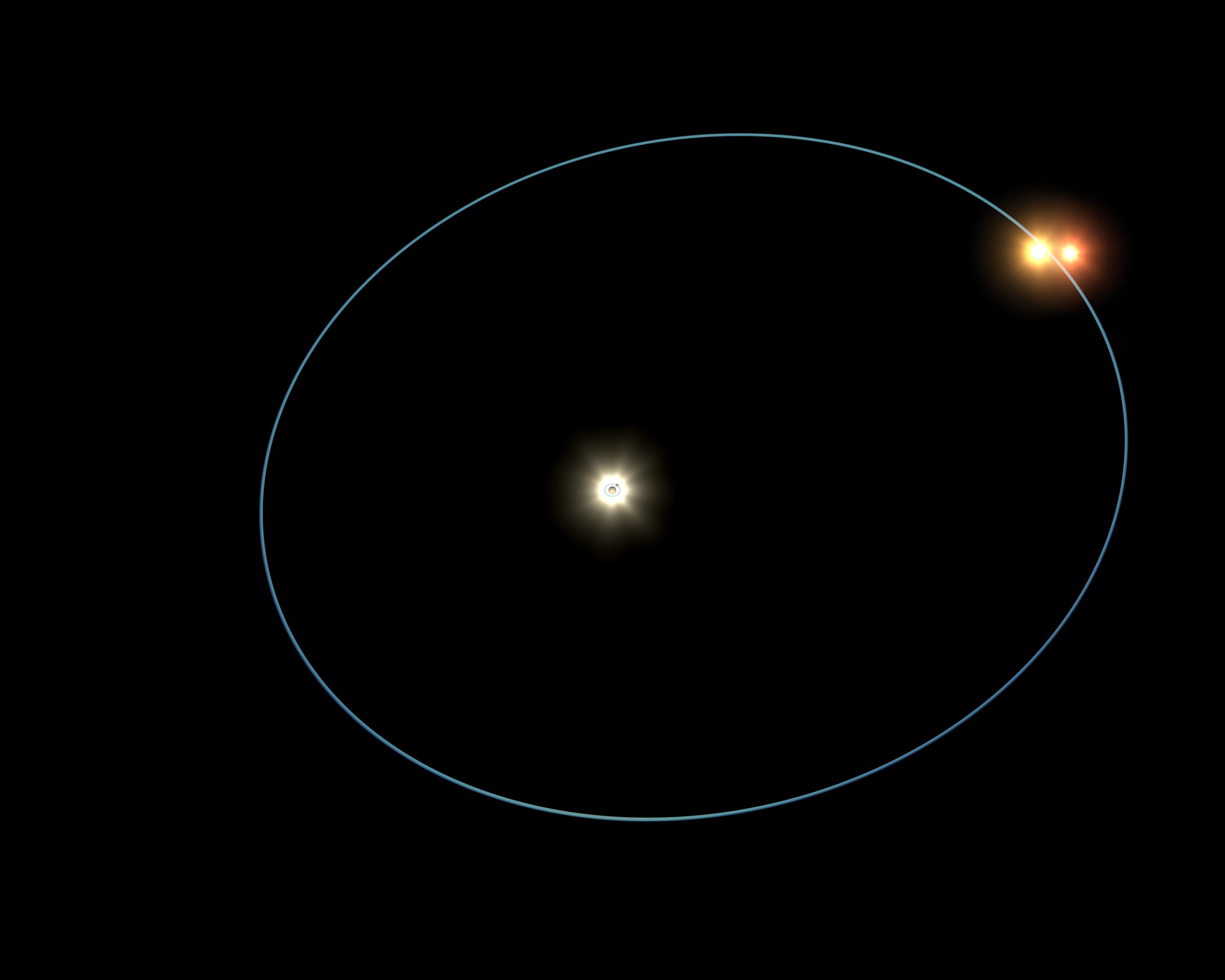
Most of the stars in the sky are not alone. They come in pairs, triples, and sometimes tangled little families orbiting around a shared center of gravity, the way our Sun would, if we had a few siblings instead of just planets. What is rare is being able to look at one of these families edge-on and watch every star in it pass in front of every other star as it goes around.
What happened
A paper led by Brian Powell of NASA’s Goddard Space Flight Center, posted to the arXiv preprint server in late May, lays out the discovery of TIC 295741342, a triple star system about 3,080 light-years away that turns out to be one of only a handful of known triply-eclipsing triples. NASA’s Transiting Exoplanet Survey Satellite (TESS), a small spacecraft that stares at large patches of sky looking for the tiny dips in brightness caused by orbiting planets, picked up an unusual repeating pattern in the system’s light.
What they found: a tight inner pair of nearly identical sun-like stars, each about one solar mass and 6,400 K (Kelvin, the absolute temperature scale used by physicists; our Sun’s surface is about 5,800 K), locked in a 4.75 day orbit around each other. Wrapped around that pair, on a wider 412.8 day orbit, is a single red giant, about 1.7 solar masses, 10.6 times the radius of our Sun, and a cooler 4,839 K, which is what gives it its orange-red color. Because the three orbits sit within about a third of a degree of the same plane, and that plane points almost exactly at Earth, every body passes in front of every other body as seen from here. The giant produces about 95 percent of the system’s light, so when the small pair tucks behind it, the light barely changes; when the small pair passes in front of the giant, they punch a distinctive notch in the brightness curve that astronomers nicknamed “head-and-shoulders.”
Why it matters
Most of what we know about distant stars comes from chains of inference: take a measurement, assume a model, propagate the error. Eclipsing systems are the rare cases where the geometry hands you the answer directly. Here the brief windows when one body slides over another lock down each star’s radius, mass, and temperature without needing those assumptions. That makes TIC 295741342 a calibration anchor for the rest of stellar astronomy, particularly for how giant stars evolve. The paper notes the data already constrain whether the giant is climbing the red giant branch for the first time or has come back around to the horizontal branch (the phase where stars fuse helium in their core), two paths with very different futures.
The other reason these triples are interesting is what they imply about how stars form. A near-perfectly coplanar triple at this separation likely formed by fragmentation inside a single disk of gas and dust, with the giant later migrating inward, rather than by random capture. That is a clean test case for stellar formation theory.
What to watch next
Powell’s team flags TIC 295741342 as a target for follow-up spectroscopy, which can directly measure the stars’ velocities and lock down the two evolutionary scenarios for the giant. Whichever one wins, this system is now a benchmark.