
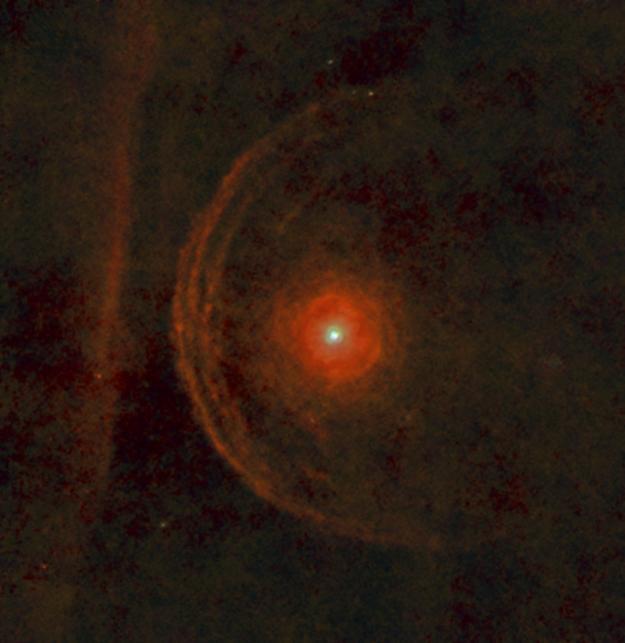
At its brightest, Betelgeuse is one of the ten brightest stars visible from Earth, a distinctive red-orange point in the shoulder of Orion. Astronomers have known for decades that it is a red supergiant near the end of its life, destined to explode in a supernova that will be visible in daytime from Earth.
In late 2019, something strange happened. Betelgeuse began to dim. By February 2020, it had faded to about 40 percent of its normal brightness, fainter than it had been in the 25-year history of reliable photometric monitoring.
The internet had thoughts.
What people feared
A star nearing supernova would show increasing variability and changes in brightness and spectral profile. Betelgeuse had been known as an irregular variable star for decades, but the Great Dimming, as it came to be called, was unprecedented in scale. Multiple astronomers pointed out, correctly, that when a red supergiant goes supernova, the warning signs might look a lot like this.
The star is about 700 light-years away. That means we are seeing it as it was 700 years ago. A supernova visible from Earth would be spectacular, not dangerous at that distance.
What actually happened
Two separate investigations, using Hubble Space Telescope observations and ground-based spectroscopy, converged on the same answer by 2022. The dimming was caused by two things happening simultaneously.
First, Betelgeuse underwent a surface mass ejection, blowing off a large cloud of gas from its outer layers. This kind of event is more violent than solar wind but analogous in character. The ejected material cooled as it moved away from the star.
Second, a pre-existing cool patch on the star’s surface called a convection cell, a giant bubble of relatively cooler plasma, was facing Earth at the same time as the mass ejection. The combination of a dark surface region and a cloud of cooling gas in the line of sight produced the observed dimming.
What it tells us
The Great Dimming was not a supernova precursor. It was a dramatic example of the mass-loss processes that red supergiants undergo regularly, just more visible than usual because it happened to be facing us.
Betelgeuse will eventually go supernova. The timing is uncertain to within about 100,000 years. Astronomers will continue monitoring it, and if the precursor signals ever do appear, the warning time will be measured in hours, not weeks. The Great Dimming was a rehearsal for that monitoring, and it taught us something valuable about how red supergiants shed mass.