
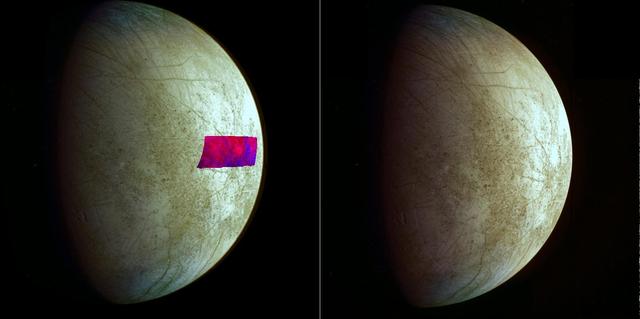
Europa is one of the strangest places in the solar system, and that is using “strange” in the most precise way available. It is a moon of Jupiter, roughly the size of our own Moon, covered in a shell of ice that floats on top of an ocean of liquid salt water perhaps a hundred kilometers deep. There is more liquid water on Europa than on the entire surface of Earth.
In October 2024, NASA launched a spacecraft toward it. In 2030, that spacecraft will arrive. And then, for four years, it will fly within 25 kilometers of Europa’s surface, repeatedly, asking the only question that matters about a place like that: is anyone home?
What is going
Europa Clipper lifted off from Kennedy Space Center on a Falcon Heavy in October 2024 and is now coasting on a six-year cruise to Jupiter. The spacecraft itself is the largest planetary science mission NASA has ever sent, about 30 meters wide with its solar arrays unfurled, which is the wingspan of a basketball court. It is large because Jupiter is far, sunlight there is roughly 1/25th of what we get on Earth, and the radiation environment near Europa is brutal enough to destroy normal electronics in days. The instruments live behind a vault of titanium and aluminum. The orbit is designed to dip in toward Europa, take readings, and run away before the radiation dose accumulates.
The science payload is built around a clear question: is Europa habitable? Not “does it have life,” that is a question for follow-on missions, but “does it have the conditions life needs?” Liquid water, the right chemistry, an energy source. Clipper carries an ice-penetrating radar to map the ocean’s depth and the ice shell’s thickness, a mass spectrometer to sample the chemistry of any plumes erupting from the surface, magnetometers to read the magnetic signature of the salty ocean below, and high-resolution cameras to map the geology in detail no telescope has matched.
Why this moon, of all of them
The criteria for life as we know it are not exotic: liquid water, a stable energy source, and an interesting chemical mix. Europa appears to have all three. The water comes from tidal heating, where Jupiter’s gravity stretches and squeezes Europa as it orbits, and the friction generates enough heat to maintain a liquid ocean under the ice for billions of years. The chemistry comes from the same tidal flexing pushing seawater through fractures in the rocky seafloor, the way hydrothermal vents on Earth churn out the conditions where some of our hardiest deep-sea life evolved. The energy source is the same: chemical disequilibrium, the kind of energy gradient that microbes on Earth happily eat for breakfast.
If you are designing a search for life in our solar system using what we actually know about how life works, Europa is somewhere between the top of the list and the only entry on it. Mars used to be wet a long time ago. Europa is wet right now.
Why we are not landing
A natural question: if the ocean is the point, why are we orbiting rather than landing and drilling through?
The honest answer is that drilling through 15 to 25 kilometers of ice on a moon half a billion miles from Earth is not a problem we yet know how to solve. The Clipper mission is designed to figure out where the ice is thinnest, where plumes are venting (some appear to be), where the surface chemistry is most interesting, to scout, in other words, for the lander that comes next. A Europa lander mission concept exists at NASA. Clipper’s data is what will tell the lander team where to go.
The bigger arc
For most of human history, the question “is there life elsewhere” has been a philosophical one, a question to argue about, not to answer. We are now alive at the moment that question becomes an engineering problem. Europa Clipper is one of three missions actively searching for habitability beyond Earth in the next decade (alongside Mars Sample Return and the JWST observations of exoplanet atmospheres). Each of them is a different cut at the same question.
Sometime in the 2030s, in plain language, we are going to know more about whether life exists elsewhere in the solar system than every previous generation of humans combined. Europa Clipper is the mission that gets us closest to a body of liquid water that could, plausibly, be home to something.
What to watch next
Clipper performs a Mars gravity assist in March 2025 and an Earth gravity assist in December 2026, the trajectory borrows velocity from inner-planet flybys to stretch its reach to Jupiter. Both are good moments for spacecraft health checks and instrument calibration runs against well-known targets. Jupiter orbital insertion happens in April 2030. The first close Europa flyby is approximately a year later.
A six-year cruise sounds slow until you remember that the first humans to seriously ask whether there might be a habitable ocean under Europa’s ice did so in the 1970s. Some answers take a generation to arrive.