
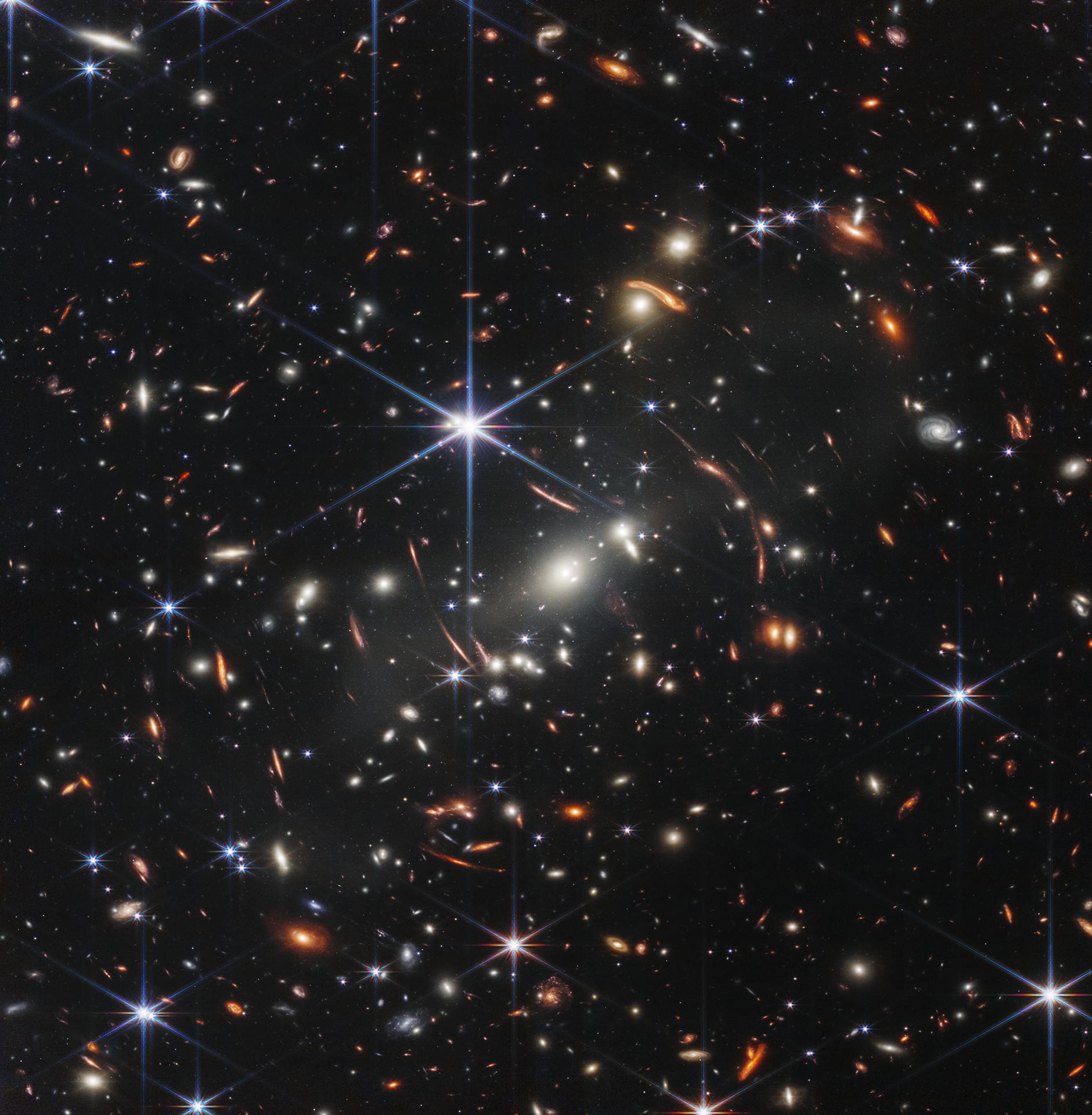
In one corner of the early universe, the black hole arrived before the galaxy. New James Webb Space Telescope (JWST) measurements of a tiny crimson object called Abell2744-QSO1 show a supermassive black hole roughly 50 million times the mass of the Sun, sitting at the center of a small galaxy seen just 700 million years after the Big Bang. Results published Wednesday in Nature and Monthly Notices of the Royal Astronomical Society describe a system in which the black hole accounts for at least two thirds of the galaxy’s total mass, an inversion of the arrangement we are used to.
The measurement was made by Webb’s NIRSpec integral field unit, an instrument that records a separate spectrum for every pixel in a small patch of sky. By tracking how hydrogen gas swirls in tight orbits around the central object, the team led by Ignas Juodžbalis and Cosimo Marconcini of the University of Florence, with Roberto Maiolino and Francesco D’Eugenio of the University of Cambridge, applied Kepler’s laws of orbital motion directly to weigh the black hole. The galaxy itself is small and dim, the sort of speck Hubble could never have resolved. In nearby galaxies, the central black hole holds only a tiny fraction of the host’s total mass. In QSO1, NASA’s release notes, the proportion is thousands of times higher.
This matters for one of cosmology’s open questions: where did the first supermassive black holes come from. The “light seed” picture has them growing from the leftovers of early stars, slowly fed by gas until they reached supermassive scale billions of years later. The numbers in QSO1 do not allow that timeline. Cambridge co-author Roberto Maiolino called the result “a paradigm shift, a total revisiting of the classical scenarios of how black holes form and grow.” The data favor a “heavy seed” pathway, in which clouds of gas collapse directly into objects tens of thousands of solar masses, or even more exotic origins. Co-author Juodžbalis flagged “evidence for primordial black holes or direct collapse black holes” as the leading candidates. QSO1 is one of the brighter examples of a class of compact red objects, nicknamed Little Red Dots, that JWST keeps finding in its deep fields and that nobody fully understands yet.
What to watch: follow-up JWST and ground-based observations of other Little Red Dots that test whether QSO1’s mass ratio is typical, or an outlier.