
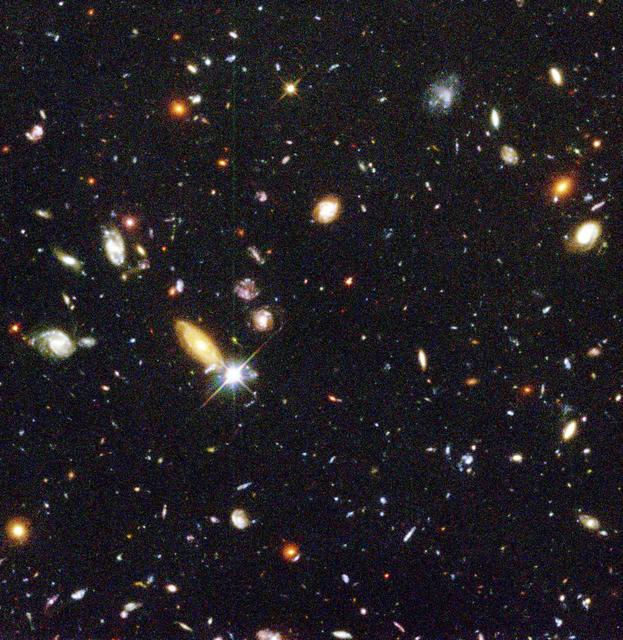
The galaxy catalogued as JADES-GS-z14-0 sits at a redshift of 14.32. Translating redshift into time: we are seeing light that left this galaxy approximately 290 million years after the Big Bang, when the universe was roughly 2 percent of its current age.
For comparison, the Sun formed about 4.6 billion years ago, when the universe was already about two-thirds of its current age. What we are looking at in JADES-GS-z14-0 is the universe as an infant, already assembling structures that our models suggest should not yet exist.
Why it matters
The redshift record itself is always interesting, but what is scientifically compelling about JADES-GS-z14-0 is what the galaxy looks like. It is surprisingly luminous, shining with the light of hundreds of millions of stars. Its size, roughly 1,600 light-years across at that early epoch, is substantial for its age.
The standard model of cosmic structure formation, called Lambda-CDM, predicts that the very early universe should be populated with small, faint, irregular proto-galaxies, the seeds from which larger structures grow over billions of years. JADES-GS-z14-0 is neither small nor faint. It is the third such anomalously large, early galaxy that JWST has discovered in two years.
Astronomers are not panicking. Anomalies in observational data routinely resolve once systematic effects are understood. But the consistency of the findings, multiple independent discoveries pointing in the same direction, is adding real pressure on models of early star formation.
What might explain it
Several explanations are being explored. One is that the initial mass function for early stars, meaning the distribution of how massive the first stars were, was skewed toward very large, very luminous stars. These stars would have lived fast, died young, and seeded their galaxies with heavy elements that enabled rapid subsequent star formation.
Another possibility is that our cosmological models underestimate the density fluctuations in the early universe, meaning the seeds of galaxies were more concentrated than expected and collapsed into stars faster.
The fact that these galaxies exist is not a crisis for cosmology. But understanding them in detail will refine our models of how the first structures in the universe formed, and JWST is the first telescope capable of providing the data needed to do that work.