
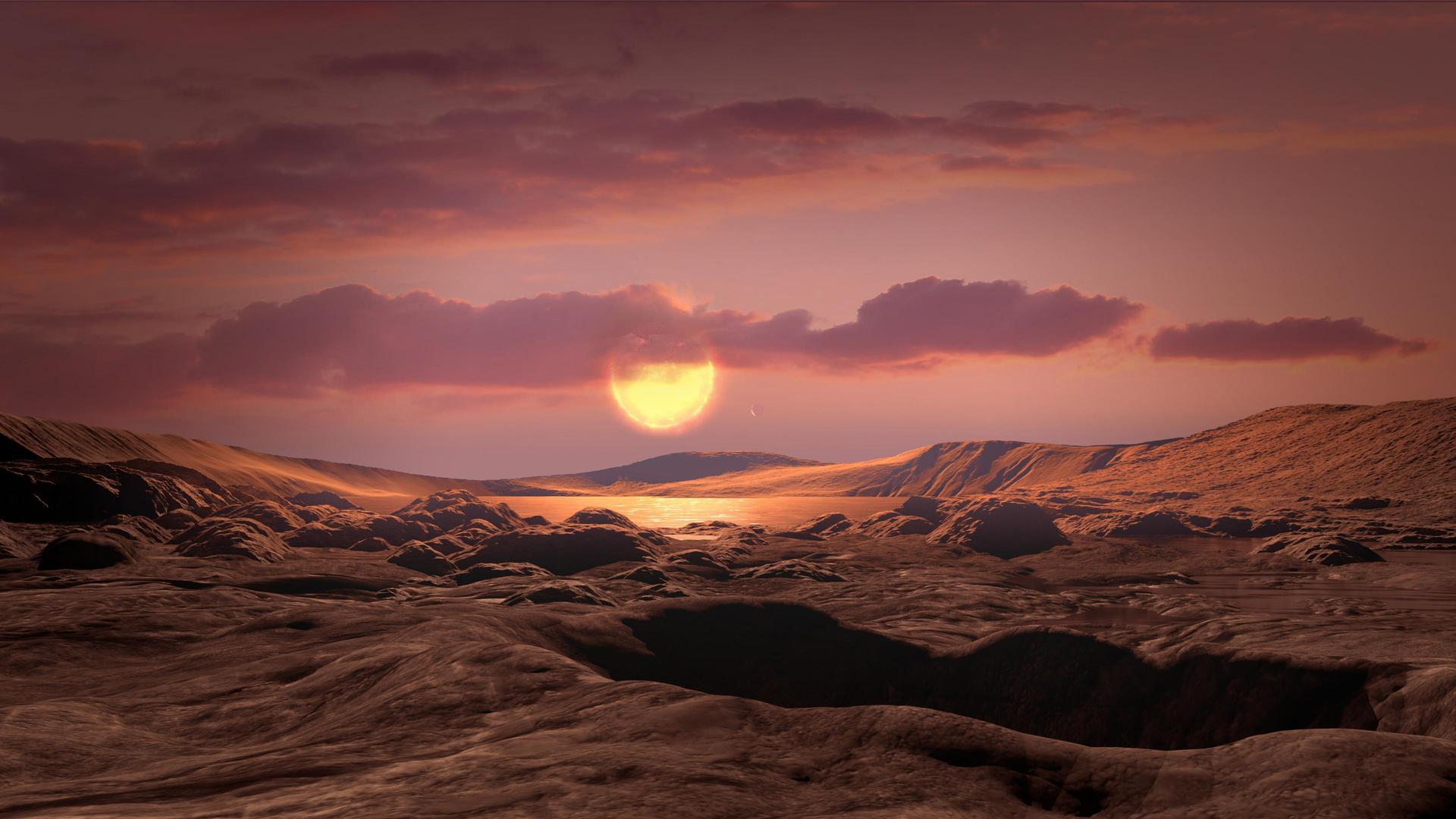
A team led by Giuseppe Conzo of the Gruppo Astrofili Palidoro reports a new planet around Ross 318, a red dwarf only 28 light-years from Earth. The world, designated Ross 318 b, has a minimum mass of 6.21 Earth masses, orbits every 39.63 days at a distance of 0.16 AU, and sits inside what astronomers call the conservative habitable zone, the band around a star where liquid water could exist on a rocky surface. The paper went up on the arXiv preprint server on May 11, 2026.
Ross 318 is an M3.5V red dwarf, a star about half the Sun’s mass with a surface temperature of roughly 3,450 K. Because the star is small and dim, its habitable zone hugs in close. Ross 318 b receives roughly the energy flux Earth gets from the Sun, with an equilibrium temperature near 237 K, about minus 36 Celsius. That is cold by the standards of a coffee shop, but it is exactly the regime where a thick enough atmosphere could lift surface temperatures above freezing.
How they found it
This is not a fresh telescope campaign so much as a careful re-reading of old data. The team combined a decade and a half of radial velocity measurements from two of the field’s workhorse instruments: CARMENES at the 3.5-meter telescope at Calar Alto in Spain, and HIRES on the Keck 10-meter on Mauna Kea. Radial velocity searches for the small back-and-forth wobble a planet’s gravity induces on its host star. For a 6 Earth-mass world tugging a half-solar-mass star at 0.16 AU, the signal sits at the edge of what current instruments can resolve.
The complication with red dwarfs is that they are noisy. Active stars spot, flare, and rotate, and any of those can mimic a planetary signal. To separate the planet from the star, the authors layered in photometry from NASA’s TESS satellite, which has been watching Ross 318 for brightness variations driven by spots rotating in and out of view. Pinning down Ross 318’s rotation period at about 51.5 days let the team subtract the stellar activity signature and isolate the 39.63-day periodicity that does not match the star’s behavior. In the team’s words, the work shows “how the synergy between multi-instrumental spectroscopy and high-precision photometry resolves ambiguities induced by stellar activity.”
Why 28 light-years matters
Distance does most of the work here. The closer a system is, the more photons reach our instruments, and the more options open up for follow-up. Ross 318 b is one of the nearest temperate super-Earths yet announced. At 28 light-years it sits inside the volume of space the James Webb Space Telescope can plausibly probe for atmospheric features, by watching the planet’s host star and looking for subtle wavelength-dependent dimming during transits, if the planet transits, or by direct spectroscopy with future instruments if it does not.
The catch: a minimum mass of 6.21 Earths is a floor, not a value. Radial velocity gives the component of mass projected along our line of sight. If the orbit is tilted, the true mass could be considerably higher, which would push the planet from super-Earth toward mini-Neptune and change what kind of atmosphere it might hold. Determining the inclination, ideally by catching a transit, would resolve that ambiguity and unlock the radius. The paper notes a likely radius of about 1.74 Earth radii based on mass-radius relations, but that is a model number, not a measurement.
What to watch for next
Three follow-ups would sharpen the picture. First, a transit search. TESS has already observed the field; targeted re-analysis or future visits could catch the planet crossing the star, if geometry cooperates. The transit probability is low for a planet at 0.16 AU, but not zero. Second, atmospheric characterization. If Ross 318 b transits, JWST could attempt transmission spectroscopy to test for water vapor, methane, or carbon dioxide signatures. Third, independent confirmation of the radial velocity signal from a different spectrograph would shore up the detection against the lingering possibility that stellar activity is faking the planet.
For now, Ross 318 b joins a small but growing roster of nearby temperate worlds, alongside Proxima Centauri b, GJ 1002 b and c, and TRAPPIST-1 e through g. None of these are confirmed to be habitable. All of them are tractable enough to be tested. That is the slow shift underway in exoplanet science: the question has moved from “are there other worlds” to “what are they actually like.” Each new entry on the list of nearby candidates is a future observation request waiting to be filed.
Sources
- Conzo et al., “Detection and Characterization of the Temperate Super-Earth Ross 318 b,” arXiv:2605.11123, https://arxiv.org/abs/2605.11123
- Phys.org summary, “Astronomers discover a super-Earth orbiting a nearby red dwarf,” https://phys.org/news/2026-05-astronomers-super-earth-orbiting-nearby.html
- Astrobiology Web, “Detection and Characterization of the Temperate Super-Earth Ross 318 b,” https://astrobiology.com/2026/05/detection-and-characterization-of-the-temperate-super-earth-ross-318-b.html
- Exoplanet.eu catalog entry, https://exoplanet.eu/catalog/ross_318_b—12304/