
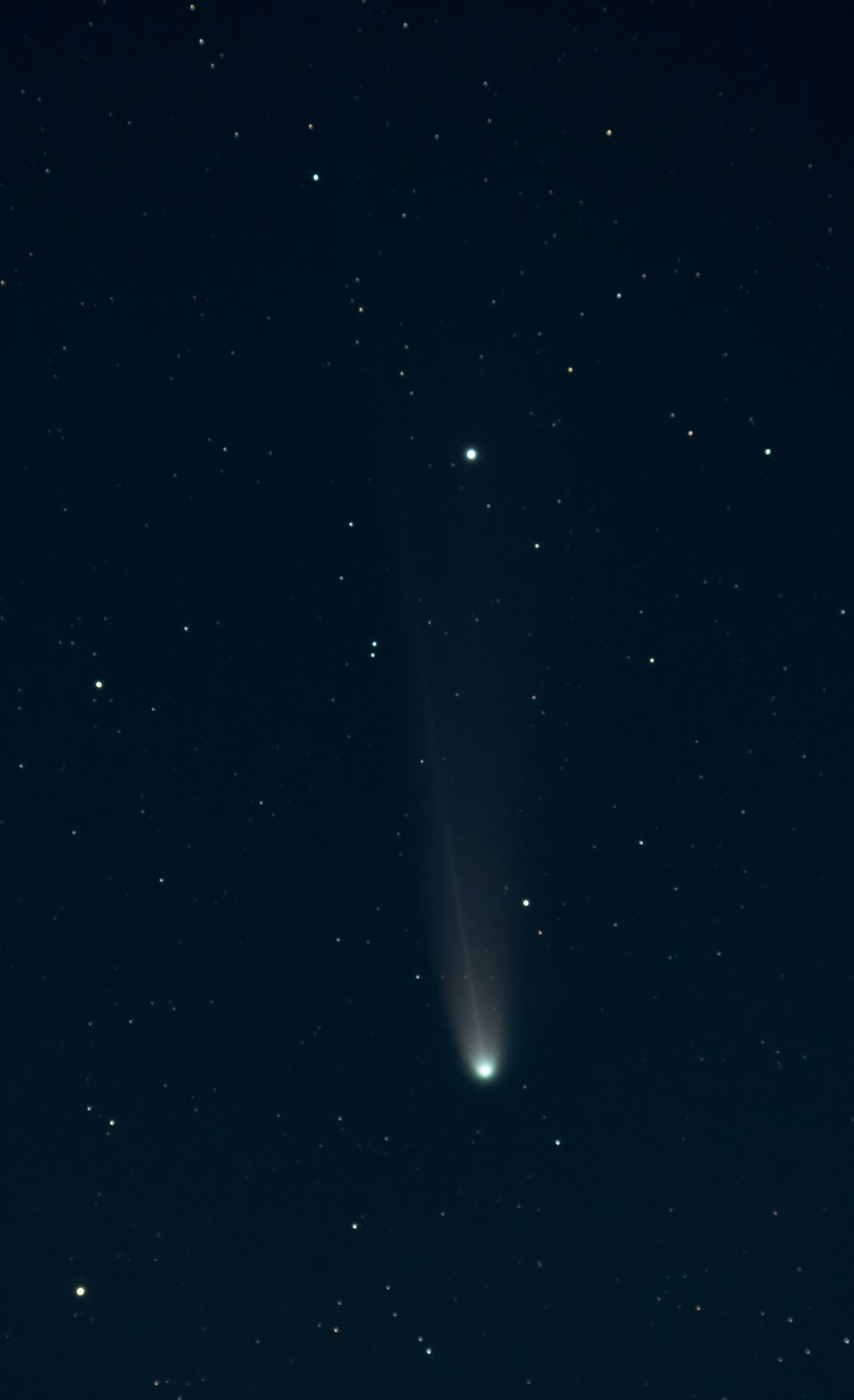
A piece of another planetary system passed through ours last fall, and the chemistry it carried looks nothing like home. 3I/ATLAS, the third interstellar object ever confirmed, made its closest approach to the Sun on October 29, 2025. Half a year of follow-up has now produced the cleanest portrait yet of an interstellar comet, and the headline measurement is simple: the water in 3I/ATLAS contains roughly 30 times more deuterium relative to ordinary hydrogen than the water in solar-system comets, and more than 40 times the ratio found in Earth’s oceans. Whatever cloud of gas and dust this object condensed out of, it was far colder than the one that made us.
What 3I/ATLAS is
3I/ATLAS was picked up by the Asteroid Terrestrial-impact Last Alert System telescope in Río Hurtado, Chile, on July 1, 2025. Its orbit eccentricity was greater than one almost immediately, the unmistakable signature of an object passing through the Sun’s gravity well rather than orbiting it. That made it interstellar, the third such visitor after 1I/’Oumuamua in 2017 and 2I/Borisov in 2019.
The nucleus turned out to be small but real: Hubble Space Telescope imaging puts its effective radius at about 1.3 kilometers, give or take 200 meters. Unlike ‘Oumuamua, which never showed a coma and confused everyone for years, 3I/ATLAS behaved like a textbook comet. As it approached the Sun it brightened, threw off gas and dust, and developed a tail. That gave spectroscopists targets to work with.
The deuterium signal
The deuterium-to-hydrogen ratio in water (D/H for short) is one of the most useful tracers in planetary science. Heavy water (HDO) preferentially forms in very cold environments, so a comet’s D/H tells you how cold it was where the comet’s ices condensed. Solar-system comets cluster around a few times the Earth-ocean value. Some are close to ocean water (which is why comets are part of the “where Earth got its water” debate). Others are a bit higher.
3I/ATLAS sits roughly an order of magnitude above all of them. The Atacama Large Millimeter Array, working at sub-millimeter wavelengths, measured HDO in the comet’s coma and reported a D/H ratio more than 30 times that of typical solar-system comets. The implication: 3I/ATLAS came from a part of its home system that was substantially colder than the equivalent zone in the early Solar System. Pre-stellar core temperatures, in other words, or a protoplanetary disk far enough from its star that ice grains spent millions of years soaking up deuterium.
A stereo view from two spacecraft
The other notable result this spring came from an opportunistic alignment. In late 2025 the comet passed through a part of the sky visible to both ESA’s Jupiter Icy Moons Explorer (Juice), then on its way to the outer solar system, and NASA’s Europa Clipper, en route to a Jupiter orbit insertion in 2030. The two probes carry similar ultraviolet spectrographs. By pointing them at 3I/ATLAS at the same time from very different vantage points, the teams produced the first simultaneous two-hemisphere look at any interstellar object. The instruments detected ultraviolet emission lines from hydrogen, oxygen, and carbon in the coma. Stereo coverage is what lets you separate sun-side production from night-side venting, and that information feeds into models of how the nucleus is rotating and where on its surface the active areas sit.
Asymmetry around perihelion
[EDITORIAL FLAG: quality — jargon undefined: “perihelion” (the closest point of an orbit to the Sun) — define on first use]
Multi-epoch optical spectroscopy from December 2025 through January 2026 found the comet’s output was lopsided. Pre-perihelion the coma was depleted in the carbon-chain molecule C2 relative to typical comets. Post-perihelion the depletion eased, and production rates for gaseous metals like neutral iron and nickel jumped. That kind of asymmetry usually means a body with regions of different composition exposed to sunlight as the rotation pole shifts orientation, or fresh subsurface material breaking through after the surface crust ablates. For an interstellar object we cannot revisit, those clues are the only window onto the layered chemistry inside.
Why this matters
Each interstellar visitor has been chemically and morphologically distinct. ‘Oumuamua was dry, small, and weird. Borisov looked like a fairly normal carbon-monoxide-rich comet but with strange CO/H2O ratios. 3I/ATLAS now adds a third data point: a clearly active comet, but with water chemistry that pegs its birthplace as a much colder regime than anywhere in our system. Three for three, every interstellar object so far has been chemically unlike the next.
The Vera Rubin Observatory, which started full operations in late 2025, is expected to push the interstellar-object detection rate from one every few years to several per year. That means the sample size, and the chance to ask whether 3I/ATLAS is a freak or a typical product of cold star-forming regions, will grow quickly through the rest of this decade. For now the comet is heading back out, slowly fading. Follow-up campaigns with Hubble and JWST will track it for as long as the signal holds.
Sources
- ScienceDaily, “Interstellar comet 3I/ATLAS contains strange water never seen in our solar system,” May 8, 2026, https://www.sciencedaily.com/releases/2026/05/260508003117.htm
- Sci.News, “Interstellar Comet 3I/ATLAS Formed in Ultra-Cold Planetary System, ALMA Reveals,” https://www.sci.news/astronomy/interstellar-comet-3i-atlas-ultra-cold-planetary-system-14727.html
- Phys.org, “Dual spacecraft capture both hemispheres of interstellar comet 3I/ATLAS at once,” https://phys.org/news/2026-05-dual-spacecraft-capture-hemispheres-interstellar.html
- arXiv:2601.21569, “Nucleus and Postperihelion Activity of Interstellar Object 3I/ATLAS Observed by Hubble Space Telescope,” https://arxiv.org/pdf/2601.21569
- arXiv:2603.07718, “Post-perihelion Coma Composition of the Interstellar Comet 3I/ATLAS from Optical Spectroscopy,” https://arxiv.org/pdf/2603.07718
- NASA Science, “How Open NASA Data on Comet 3I/ATLAS Will Power Tomorrow’s Discoveries,” https://science.nasa.gov/open-science/interstellar-comet-3i-atlas-data/
- 3I/ATLAS, Wikipedia, https://en.wikipedia.org/wiki/3I/ATLAS