
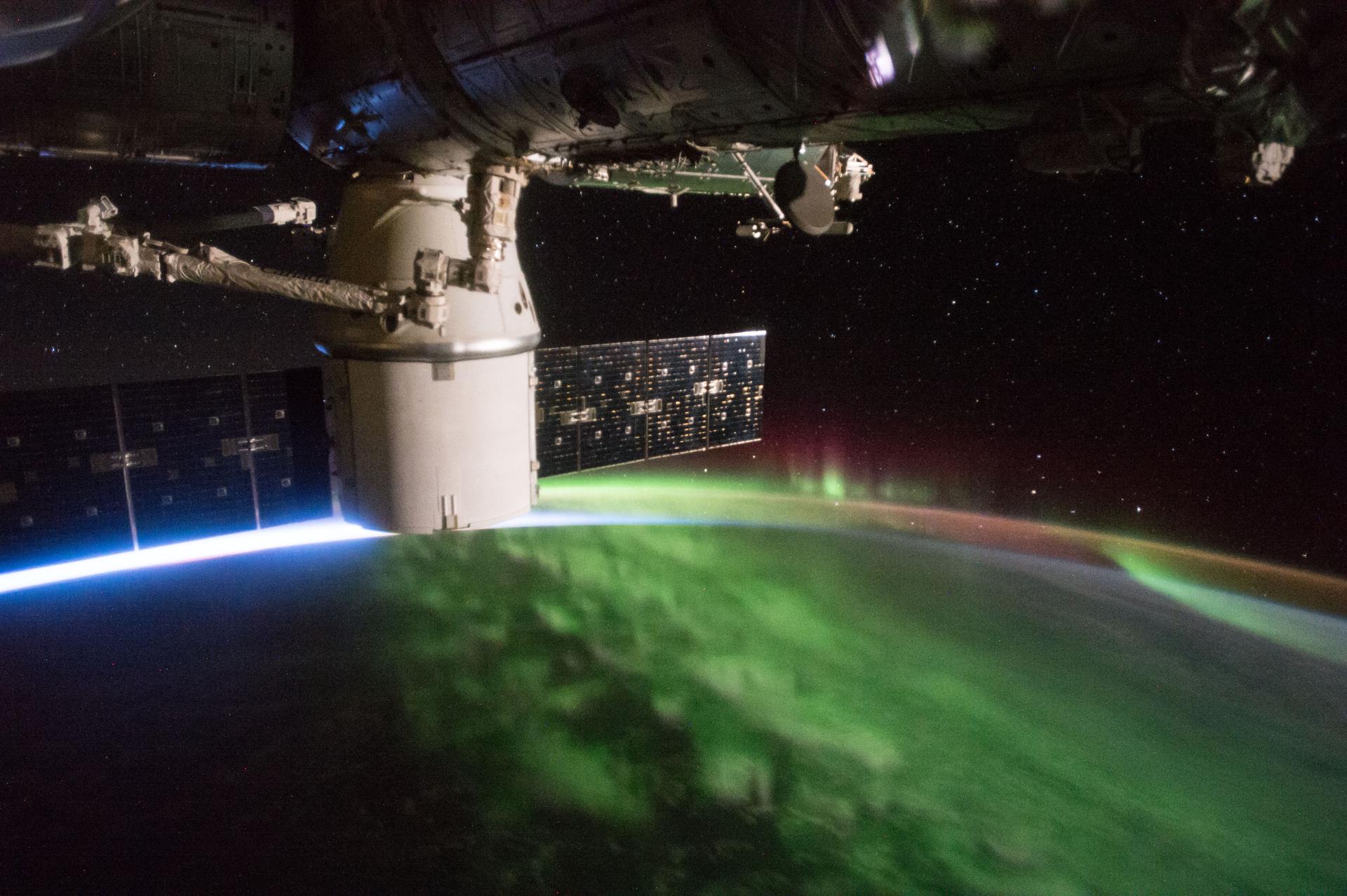
The bubble of magnetic field wrapped around Earth has been keeping the Sun’s radiation from sterilizing the planet for roughly four billion years. Until this week, no one had taken a wide-angle picture of it. That changes now.
A joint mission between the European Space Agency and the Chinese Academy of Sciences, called SMILE, lifted off on a Vega-C rocket from Kourou, French Guiana, at 3:52 a.m. UTC on May 19 (11:52 p.m. Eastern time on May 18). The acronym stands for Solar wind Magnetosphere Ionosphere Link Explorer. Roughly 56 minutes after liftoff, the rocket deployed the spacecraft into a circular orbit about 707 km (439 mi) above Earth. Over the next 25 days, SMILE will perform 11 engine burns to climb into its working orbit: a highly elliptical loop that swings 121,000 km out above the North Pole and back down to 5,000 km above the South Pole roughly every two days.
The instrument doing the headline work is a soft X-ray imager, contributed by ESA and built at the UK’s University of Leicester. Soft X-rays here refer to the low-energy end of the X-ray spectrum, the kind that gets emitted when the solar wind, the constant stream of charged particles flowing off the Sun, collides with neutral atoms drifting out of Earth’s upper atmosphere. That collision happens along the boundary where Earth’s magnetic field meets the solar wind, a region called the magnetopause. Past missions like NASA’s Magnetospheric Multiscale and ESA’s Cluster have mapped that boundary one point at a time, dipping in and out of it with single-point sensors. SMILE will image the whole interaction at once, the way a weather satellite images a storm system instead of dragging a thermometer through it.
Three more instruments, contributed largely by Chinese institutions, will round out the picture. An ultraviolet imager will watch the auroral ovals at both poles, where the solar wind’s energy finally reaches Earth’s atmosphere. A light ion analyser and a magnetometer will measure the local plasma and magnetic field around the spacecraft itself. Together, those four instruments let scientists connect what is happening at the magnetopause to what is happening at the poles in close to real time.
The mission is built for a three-year science campaign, with more than 250 scientists across Europe and China on the team. Its working orbit is designed for patience. From apogee, SMILE can stare at the magnetosphere for more than 40 hours at a stretch without Earth blocking the view, long enough to watch a single solar storm move through the system from arrival to aftermath.
What to watch next: SMILE has to finish its 25-day orbit-raising sequence before science operations begin. ESA expects first calibration images later this summer, with the first full magnetopause sequences in the fall.