
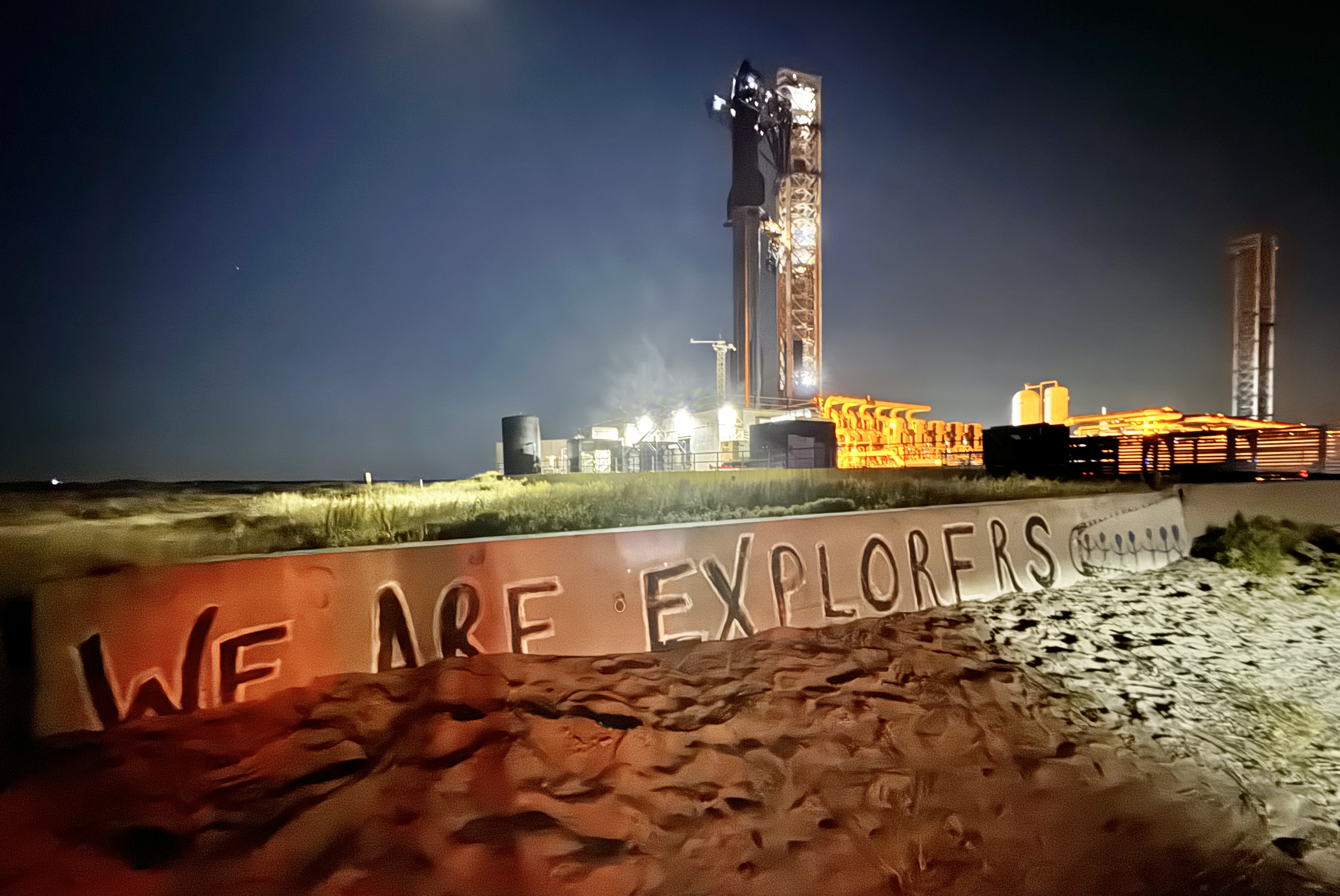
The first Starship V3 is stacked on the pad at Starbase in South Texas, the tallest and most powerful version of the rocket SpaceX has built yet. If the weather and the countdown hold, it flies Thursday, May 21, during a 90-minute window opening at 6:30 p.m. EDT.
It will also be Starship’s first flight in roughly seven months, the longest gap since the program began launching from Starbase in 2023. V2 finished its test campaign last year. This is the V3 baseline’s debut.
What is flying
The Super Heavy booster carries three grid fins, the steerable surfaces that control it during reentry, down from four on previous versions. SpaceX says the larger fins should give more control authority on the way down. The Ship, the upper stage, has a redesigned heat shield, structural reinforcements, and a flight profile that intentionally pushes harder on the parts most likely to fail.
What it carries
Roughly 22 dummy Starlink satellites, shaped and weighted like the real thing but with no working hardware, plus two modified mass simulators carrying cameras pointed back at the Ship to film its heat shield as it reenters. There is no operational payload on this flight. The goal is data, not delivery.
The flight profile
Total mission time is about 1 hour 5 minutes. The booster separates from the Ship at roughly 2 minutes 22 seconds and splashes down in the Gulf of Mexico about 7 minutes after launch. No attempt this time to bring it back to Starbase to be caught by the launch tower’s mechanical arms, the maneuver SpaceX calls a tower catch. SpaceX says Pad 2’s faster catch arms are still being commissioned. The Ship continues on a suborbital trajectory, deploys the dummy Starlinks around 8 minutes in, then coasts most of the way around the planet before splashing down off Western Australia at roughly 1 hour 5 minutes after liftoff.
What is actually being tested
Three things in particular. First, the heat shield: engineers have deliberately removed one tile to see how the neighbors behave under reentry heating, the kind of test you can only run when you are willing to lose the vehicle. Second, the rear flaps: the Ship will perform aggressive flap maneuvers during reentry to stress hinges and actuators. Third, a dynamic banking maneuver intended to simulate the steeper return profile a future operational Starship will need when it eventually tries to land where it started.
Why it matters
Starship is the rocket the rest of the new space race is now waiting on. NASA’s Artemis III crewed lunar landing depends on a Starship variant ferrying astronauts from lunar orbit to the surface. SpaceX’s own next-generation Starlink satellites can only be deployed on Starship-class vehicles. The economic case for a sustained lunar return and the long-term case for getting humans to Mars both run through this hardware.
What to watch for
Hot-staging separation, when the Ship’s engines light while still attached to the booster. The booster’s landing burn over the Gulf. Heat shield tile behavior visible in onboard camera footage during reentry. And the Ship’s banking maneuver and splashdown off Australia, the part SpaceX has not done cleanly before.