
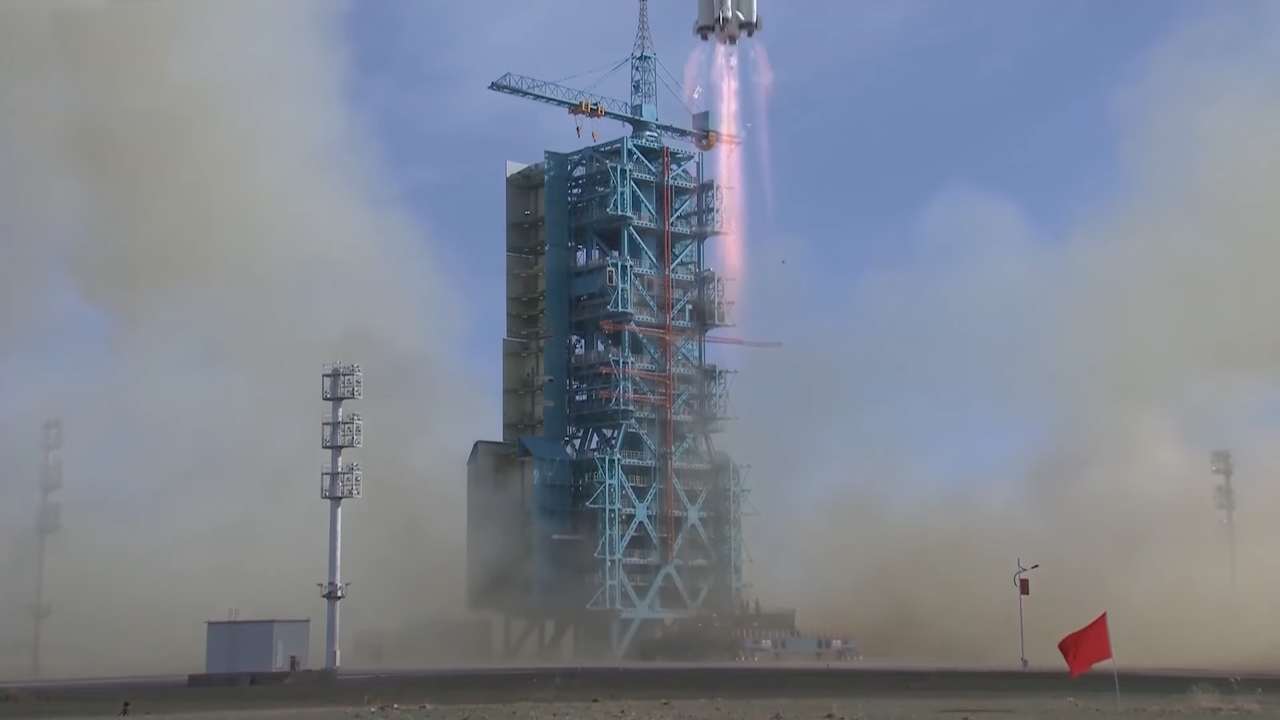
China’s third permanently inhabited space station crossed another quiet threshold this weekend. Shenzhou 23 lifted off Sunday from the Gobi Desert carrying three astronauts toward Tiangong, including the first crew member born and raised in Hong Kong and one who is expected to stay in orbit for a full year.
What happened
A Long March 2F rocket cleared the pad at the Jiuquan Satellite Launch Center at 11:08 a.m. EDT (1508 GMT, 11:08 p.m. Beijing time) on May 24, the 11th crewed flight to the Tiangong space station and the 17th crewed Chinese spaceflight overall. The crew is commanded by Zhu Yangzhu, a second-time flier who flew on Shenzhou 16, with rookies Zhang Zhiyuan and Lai Ka-ying alongside him. Lai, a payload specialist, is the first person to fly to space since Hong Kong became a special administrative region of China in 1997. Shenzhou 23 docked with the Tianhe core module’s nadir port to begin a planned roughly six-month rotation, taking over from the Shenzhou 21 crew, whose return to Inner Mongolia is scheduled for May 29.
One detail makes this rotation different. The China Manned Space Agency has said that one of the three crew members will remain aboard Tiangong for about a year rather than the usual six months, a first for China. The agency has not yet named which astronaut will stay. The extended stay is timed to allow a Pakistani astronaut, either Muhammad Zeeshan Ali or Khurram Daud, to visit on Shenzhou 24 in October without bumping a Chinese crew member off the manifest.
Why it matters
Tiangong was supposed to be a stepping stone, and it is starting to behave like one. China is now running a continuous crewed presence in low Earth orbit (LEO, the band of space below about 2,000 km where the ISS and Tiangong both fly), rehearsing the long-duration medicine, life support and crew rotation logistics that a lunar program demands. Pushing one astronaut to a year on station begins to close the gap with the kind of endurance data NASA and Roscosmos have spent two decades collecting on the International Space Station. It is the boring, expensive groundwork without which a 2030s crewed lunar landing remains a slide deck.
The Hong Kong selection is the other half of the story. China has used recent Shenzhou missions to broaden the human face of its program, first to include a payload specialist track open to civilian scientists, now to include candidates from the special administrative regions. Lai’s flight is real engineering, not symbolism alone, but the symbolism is the point: a national space program that visibly belongs to more than the cosmonaut corps it grew out of, recruiting in the same way the United States and Europe learned to.
What to watch next
The Shenzhou 21 return capsule lands in Inner Mongolia on May 29, and CMSA is expected to confirm which Shenzhou 23 crew member draws the year-long assignment in the weeks after handover.