
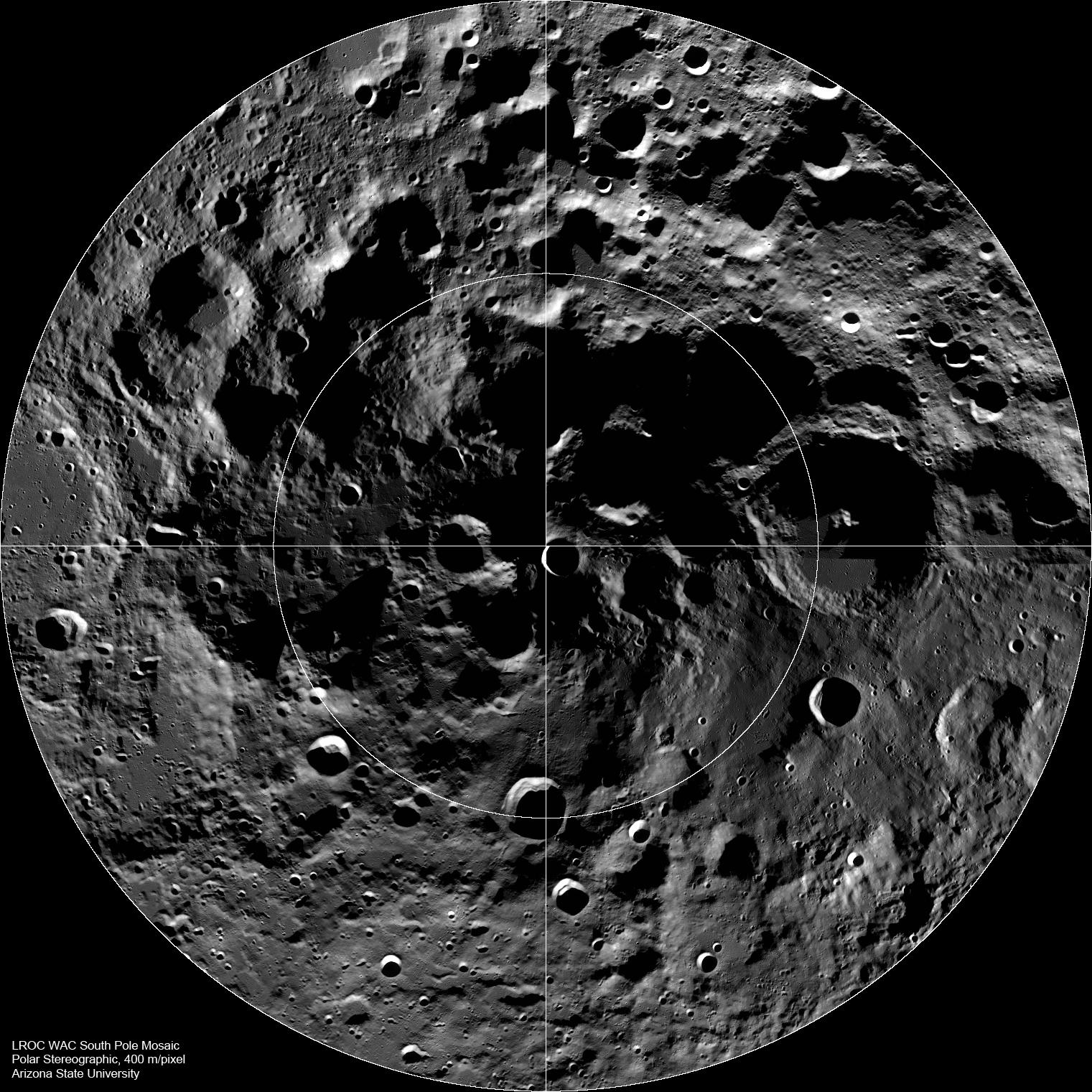
The last time the United States said it would build a base on the Moon, the plan stayed a slide deck. On Tuesday in Washington, NASA put nearly $1 billion of contracts behind the words and named the companies, vehicles, and dates that have to deliver if a permanent lunar presence is going to be more than rhetoric this time around.
What happened
NASA Administrator Jared Isaacman and Moon Base program executive Carlos García-Galán laid out a phased architecture covering 2026 through 2036, with the south polar region as the construction site. Phase One, running through 2029, costs roughly $1 billion and is meant to deliver the first surface assets before crews arrive.
The Phase One contracts:
- Astrolab (California): about $220 million to build the Crewed Lunar Vehicle CLV-1, an open-cockpit rover capable of both astronaut driving and remote operation from Earth.
- Lunar Outpost (Colorado): about $220 million for its competing Pegasus rover, which will fly on a separate mission to provide redundancy.
- Blue Origin: $234 million per rover delivery to land each Lunar Terrain Vehicle on a Blue Moon Mark 1 lander.
- Firefly Aerospace: $75 million to deliver a batch of MoonFall hopping drones in 2028 aboard its Elytra Dark spacecraft.
The MoonFall drones are roughly the size of a microwave, designed to hop across the polar terrain on small thrusters and survive about 14 Earth days each before their batteries fail. Their job is to scout the landing zone, mark the future base perimeter, and inspect places too dangerous to drive a crewed rover. Three near-term missions are now slotted to begin deploying hardware: Blue Origin’s Blue Moon Mk.1 in fall 2026, Astrobotic Griffin-1 in late 2026, and Intuitive Machines IM-3 in late 2026.
Why it matters
The lunar south pole is the target for one reason: water ice. Permanently shadowed craters near the pole are cold enough (about 40 K, or roughly minus 230 C; K is the Kelvin scale physicists use, where 0 is absolute cold) that water deposited by billions of years of comet impacts has accumulated and stayed. Ice means oxygen to breathe, hydrogen for rocket propellant, and water to drink, all of which weigh many times more on Earth than the launch cost of the equipment used to extract them on the Moon. A base built next to ice is the difference between resupplying everything from home and operating partly off the local environment.
It is also the first time since Apollo that the United States is funding the slow, unglamorous part: rovers, drones, landers, ground trucks. “We are leveraging the NASA playbook from the 1960s,” Isaacman said, “figuring out what works and what doesn’t in this epic science of survival because the Moon Base is as beautiful as it is hostile.” The rhetoric leans heavily on staying rather than visiting. Whether that holds across administrations and budget cycles is the open question.
What to watch next
Blue Origin’s Blue Moon Mk.1 robotic landing this fall is the first real test of the architecture. If it lands and offloads its payload as planned, Phase One has a credible path. If it doesn’t, the 2028 crewed Artemis IV landing slips and the rest of the schedule slips with it.