
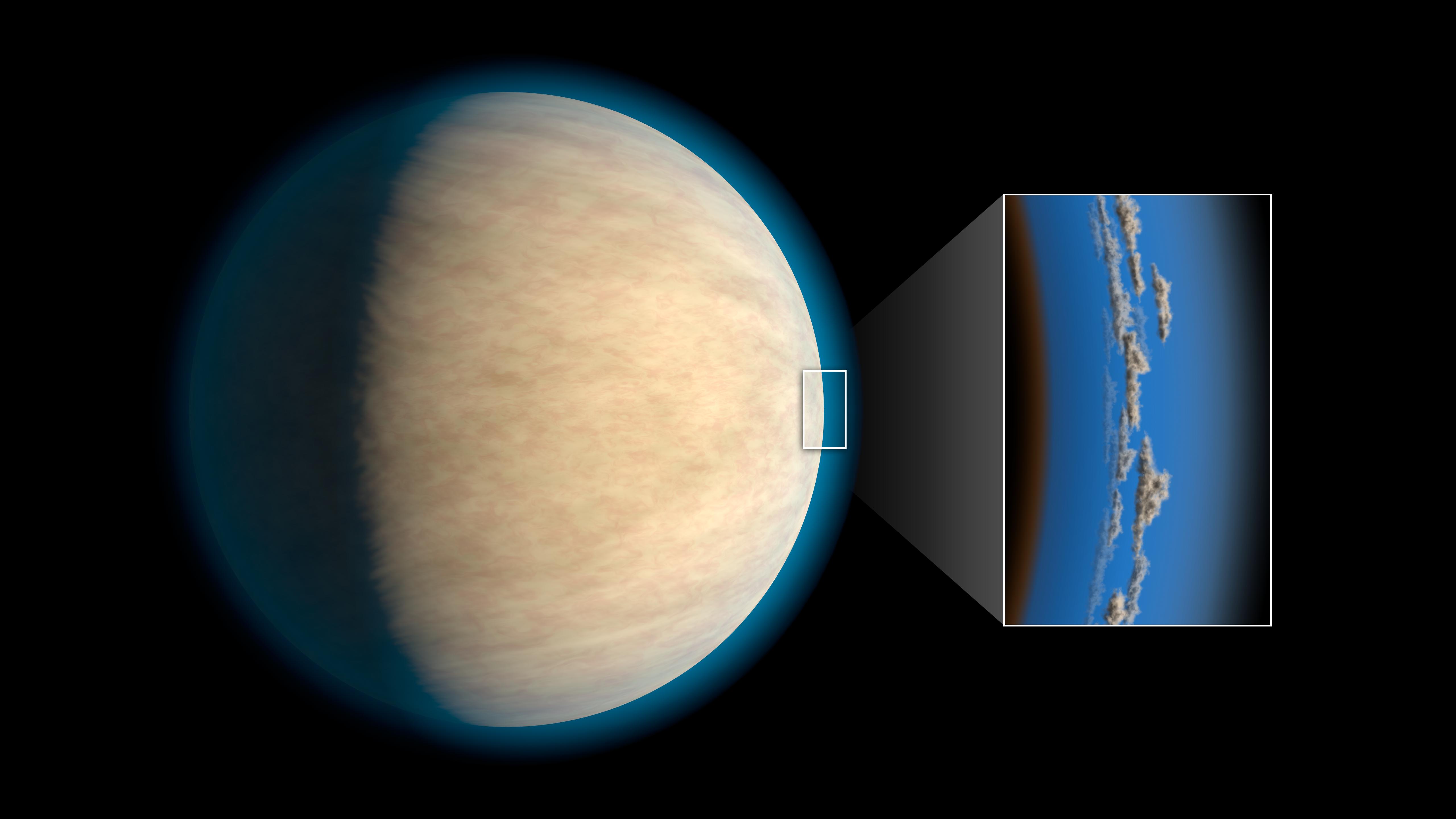
Almost every gas giant astronomers have been able to study up close is either a roasted hot Jupiter or a frozen ice world far from its star. The James Webb Space Telescope has now done something different. For the first time, scientists have measured the atmosphere of a gas giant with temperatures close to those at Earth’s surface, and they found methane waiting there.
What happened
The planet is TOI-199b, a Saturn-mass world more than 330 light-years away that orbits a Sun-like star every 100 days or so, with an equilibrium temperature (the temperature a planet settles at given the starlight it absorbs) of about 350 kelvin, roughly 175 degrees Fahrenheit. A team led by Aaron Bello-Arufe and Renyu Hu at NASA’s Jet Propulsion Laboratory, with colleagues at Penn State, Caltech, Carnegie, Arizona State, Johns Hopkins and UC Santa Cruz, used JWST’s NIRSpec instrument in its G395M mode to watch the planet pass in front of its star for seven hours, bracketed by 20 continuous hours of baseline observations. The technique, transmission spectroscopy, reads which colors of starlight are blocked by molecules in the planet’s atmosphere as the light filters through on its way to us. The spectrum revealed methane (CH4) with overwhelming statistical confidence, a Bayes factor of about 700, in a cloudy atmosphere consistent with a solar metallicity, meaning the heavier elements are in roughly the same proportions as in the Sun. [EDITORIAL FLAG: quality — jargon undefined: “Bayes factor”] The paper appeared May 20 in The Astronomical Journal.
Why it matters
Up to now the temperate gas giants, the ones that sit in the comfortable middle ground neither searing nor frozen, have been a near-total blind spot. They are rare in the catalog because they take months to transit and their atmospheres are hard to probe, and yet they are the worlds most useful for testing our theories of how giant planets form, evolve and weather. The methane detection on TOI-199b is the first chance to check those theories against a real spectrum at a temperature regime that has eluded every telescope before Webb. The chemistry it suggests, cloudy and roughly solar in composition, is the sort of thing models predict for our own Jupiter and Saturn at their formation, and seeing it elsewhere is how we learn whether our solar system is a normal outcome or an oddball.
There is a longer arc here too. The same instrument and the same technique are how astronomers will eventually look for biosignatures, fingerprints of life, in the atmospheres of rocky planets around small stars. Each new molecule confidently retrieved from a transit spectrum, each new temperature regime mapped, is another rung climbed on a ladder that ends in the question of whether the chemistry of life is rare or common in the galaxy. A methane line in a 175-degree Saturn is not that answer, but it is a measurement made the way that answer will eventually be made.
What to watch next
The team has flagged hints of ammonia and carbon dioxide in the same spectrum that need a deeper observation to confirm, and TOI-199b is now a prime candidate for follow-up JWST time and for the next generation of exoplanet missions.