
[EDITORIAL FLAG: factual — no inline-linked sources for specific claims (ice/ocean thickness ranges, Europa Clipper instrument capabilities, Galileo magnetic field measurements). Per the style guide, posts/ claims should be traceable to inline-linked sources.]
The search for life beyond Earth has been, for most of its history, focused on Mars. Mars is the most Earth-like planet in the solar system. It once had liquid water on its surface. It may still have water underground. The Viking landers of the 1970s were designed to detect Martian life. They did not find conclusive evidence of it.
Mars remains scientifically important. But in the last twenty years, the astrobiological conversation has shifted. A growing number of scientists argue that if life exists in our solar system beyond Earth, the most likely place to find it is not the Red Planet. It is a moon of Jupiter that most people cannot name off the top of their head.
What Europa is
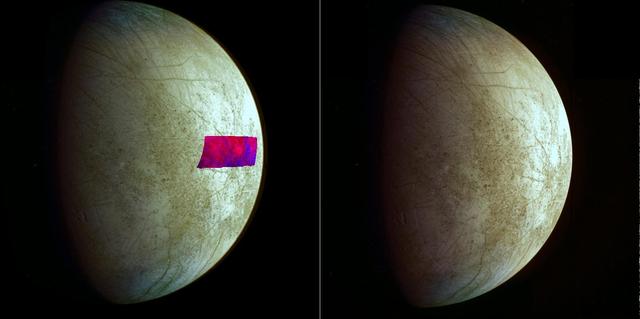
Europa is the fourth of Jupiter’s Galilean moons, slightly smaller than Earth’s Moon, covered in ice, and orbiting Jupiter at a distance that places it squarely in the intense radiation environment produced by the planet’s enormous magnetic field. From a distance, it looks hostile to life.
The key is what is below the surface. Multiple lines of evidence, including the Galileo spacecraft’s magnetic field measurements in the late 1990s, strongly suggest that Europa has a liquid water ocean beneath its icy crust. The ice is estimated to be 15 to 25 kilometers thick. The ocean below it is estimated to be 60 to 150 kilometers deep, containing more liquid water than all of Earth’s oceans combined.
The heat source keeping that ocean liquid is tidal flexing. Jupiter’s gravity, combined with the gravitational tugs from the other Galilean moons, kneads Europa’s interior continuously. This mechanical deformation generates heat. The same process is happening on Io, the innermost Galilean moon, but there the effect is so strong it makes Io the most volcanically active body in the solar system. On Europa, it is gentler, more consistent, and has been operating for the entire age of the solar system.
Why an ocean is not enough
Water is necessary for life as we know it, but not sufficient. What else does Europa offer?
The ocean floor. This is where the scientific case gets genuinely compelling. On Earth, hydrothermal vents on the deep ocean floor support entire ecosystems that never see sunlight. The chemistry works through chemosynthesis: microorganisms use the chemical energy released by water reacting with hot rock to drive their metabolism. The life at these vents has no dependence on the surface photosynthesis that powers most of Earth’s biosphere.
Europa’s ocean is almost certainly in contact with a rocky seafloor, and tidal heating is likely driving geothermal activity at the bottom of that ocean. The chemistry could be running. The question is whether the complexity of organic molecules is there.
Organic molecules are not restricted to biology. They form throughout the universe from simple chemistry. But the concentration and complexity of organics in a warm, liquid environment in contact with mineral surfaces over geological timescales could, theoretically, cross the threshold into something self-replicating.
The radiation problem, addressed
Europa’s surface is bombarded by radiation from Jupiter’s magnetosphere. Any organism on the surface would be killed quickly. But the ocean is shielded by kilometers of ice. The question is whether radiation interacting with the surface actually helps habitability rather than harming it.
The answer may be yes. Radiation hitting the icy surface drives chemistry that produces oxidants, including hydrogen peroxide and other compounds. If these oxidants are cycled downward into the ocean through processes like resurfacing, they provide chemical fuel for metabolism. The cycle from surface radiation to ocean chemistry could be an energy pathway that life might exploit, not a barrier to life but a potential power source.
The evidence from the surface
Europa’s surface is a global crackwork of fractures called lineae. These form when the ice above the ocean flexes and fractures, allowing material from below to well up and freeze. The geometry and chemistry of these features provide windows into the ocean beneath.
Data from the Galileo mission and Hubble observations of possible plume activity suggest that material from the ocean occasionally vents through the ice and into space. If true, this means a spacecraft flying through those plumes could sample the ocean’s chemistry without ever landing or drilling.
This is exactly what Europa Clipper, launched in October 2024, is designed to investigate. Its mass spectrometer can analyze material in plumes and on the surface. Its ice-penetrating radar will map the ice thickness and look for liquid water pockets near the surface. Its thermal imager will find regions of anomalously warm ice that might indicate recent water activity from below.
The competition
Mars has a longer history of surface exploration and a more established research community. But the case for Mars life depends on life surviving in briny subsurface aquifers with intermittent liquid water and significant radiation exposure through the thin crust. The chemistry is constrained. The energy gradients are shallow.
Europa’s ocean is large, stable, likely warm at the floor, chemically connected to a rocky seafloor, and has been in this state for potentially four billion years. That is a long time for chemistry to explore the space of possible reactions. Whether that exploration produces life depends on factors we do not fully understand.
But if the question is “where in the solar system are the conditions for life most similar to places on Earth where we know life exists,” the answer is the deep ocean hydrothermal vents. The closest analog to those conditions anywhere beyond Earth is not Mars. It is Europa.
What finding life there would mean
Finding evidence of life in Europa’s ocean would be among the most significant scientific discoveries in human history, second only to first contact in terms of philosophical impact. It would tell us that life is not a fluke of Earth’s particular history. It would tell us that the universe is probably teeming with biology wherever the conditions are favorable.
It would also raise immediate questions we are not prepared to answer. What kind of life? How does it relate to Earth life, if at all? Is it convergent chemistry arriving at the same solutions, or evidence of a common origin, or something genuinely alien in its biochemistry?
The Europa Clipper mission will not answer those questions. It will tell us whether the conditions for life are present. If they are, the argument for a lander mission, with the capability to search directly for biosignatures, becomes overwhelming.
That mission does not yet exist in funded form. But Europa Clipper is the necessary first step, and it is on its way.