
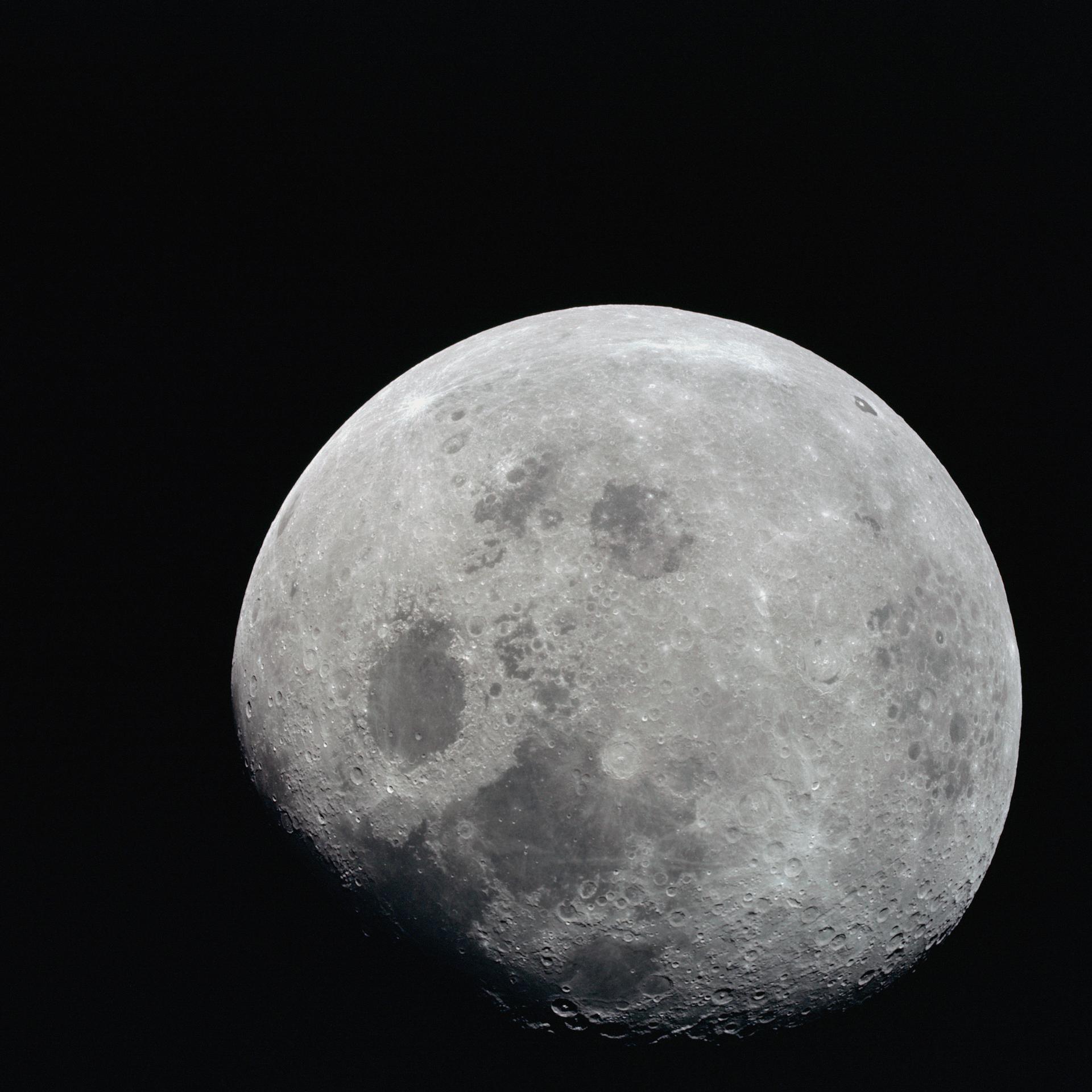
There is a region near the bottom of the Moon where the sunlight strikes at such a shallow angle that the inside of certain craters has been dark for billions of years. Water that drifted there on the backs of comets, the leftover plumbing of the early solar system, never evaporated. It is one of the most consequential places in our solar neighborhood, and until August 2023, no spacecraft had ever landed near it.
Then India did.
What happened
Chandrayaan-3’s Vikram lander touched down at roughly 70 degrees south latitude, about 600 kilometers from the lunar south pole itself, and far closer than any of the equatorial landing sites favored since Apollo. The Indian Space Research Organisation (ISRO) became the fourth space agency to soft-land on the Moon, and the first to do it down there.
The achievement also landed days after Russia’s Luna-25 probe crashed in the same target region. The contrast was hard to miss. ISRO had pulled off, on a $75 million budget, what Roscosmos could not.
Vikram’s Pragyan rover (pragyan, Sanskrit for “wisdom”) rolled out and operated for roughly two weeks before the two-week lunar night put it permanently to sleep. In that window it crossed about 100 meters of regolith and returned the first direct elemental readings from the high southern latitudes, aluminum, silicon, calcium, iron, titanium, manganese, and importantly, sulfur, which had never before been directly measured at the surface in that region.
Why this corner of the Moon
The lunar south pole is not arbitrary real estate. The permanently shadowed craters at the poles are cold traps, surfaces that have never seen the Sun and never will, where temperatures sit near minus 250 degrees Celsius. Volatiles delivered by impacts over four billion years accumulate there and stay there. Water ice, in particular.
That ice is two things at once. To science, it is a frozen archive of the early solar system’s chemistry, a record of what was being delivered to the inner planets back when Earth’s own oceans were arriving. To anyone planning a sustained human presence on the Moon, it is drinking water and rocket fuel that does not need to be flown up from Earth at $1.2 million per kilogram (current Falcon 9 delivered cost, lunar-equivalent).
Pragyan did not land directly on a known ice deposit. Its site was chosen for scientific yield, not ice-bagging. But every soft landing closer to the pole is data the engineers planning crewed missions need: how the terrain handles, how the regolith behaves, how navigation sensors cope with the long shadows.
Why it matters for the bigger arc
The new space race is sometimes framed as US versus China, with everyone else as a side note. Chandrayaan-3 is the counter-example. India built precision lunar landing capability, guidance, navigation, throttleable descent propulsion, on a budget smaller than a single Falcon Heavy launch. There are now four space agencies that have soft-landed on the Moon, and the fourth one did it for less than the catering budget of a NASA flagship.
The capability is no longer the unique property of superpower-scale programs. That is a different kind of space race than the one most people are watching.
What to watch next
ISRO has signaled that follow-on missions will push closer to the pole and aim for longer surface operations, eventually including a sample return. The agency’s stated long-arc goal is a crewed lunar mission in the 2040s. Whether the schedule holds is a separate question (every space program slips). But the Chandrayaan-3 landing established that the engineering base is real, and that is the part that compounds.