
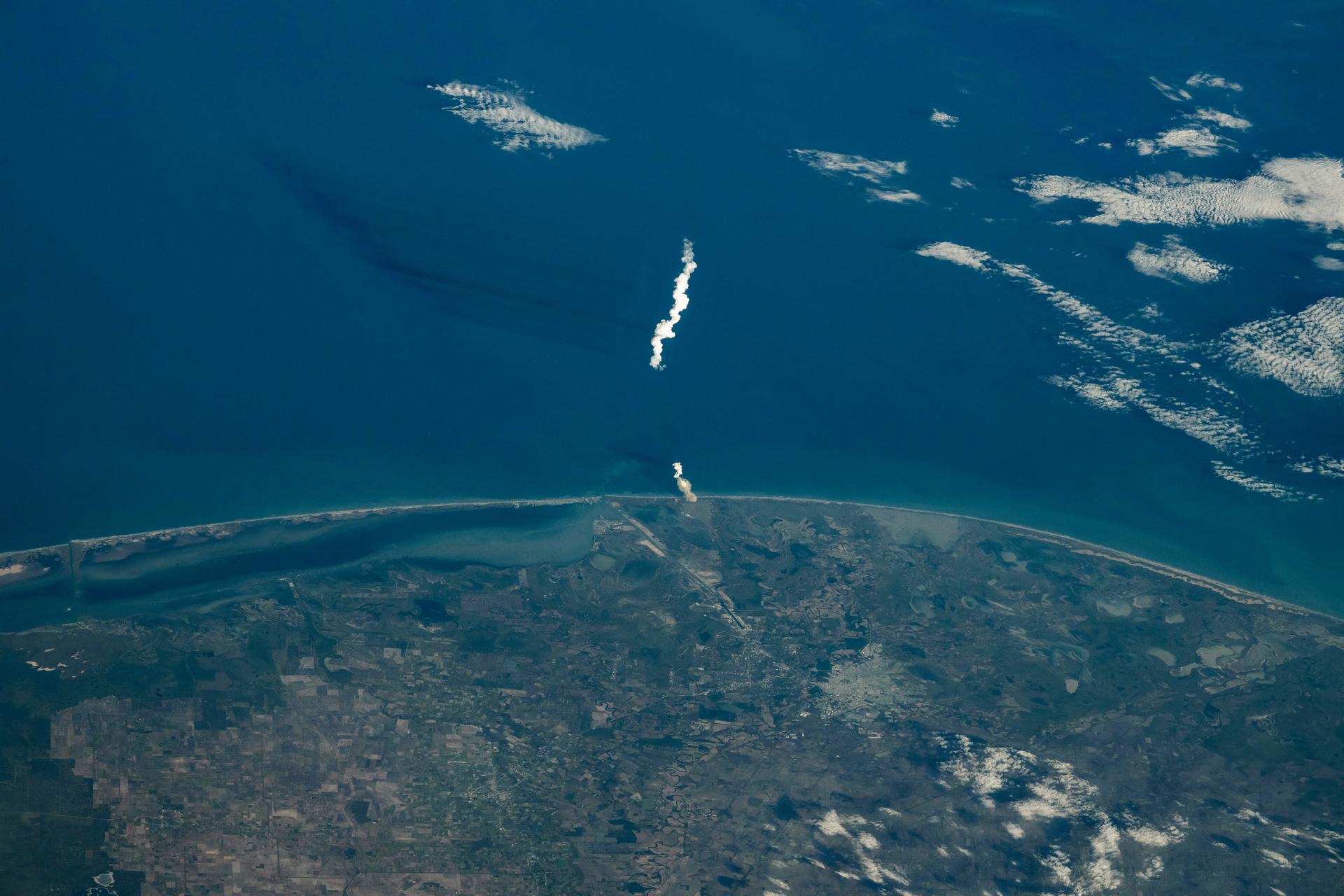
The vehicle that took off from the southern tip of Texas in June 2024 was 121 meters tall, taller than the Saturn V that took astronauts to the Moon, almost double the height of the Statue of Liberty. It was carrying 4,600 tonnes of methane and liquid oxygen. When the 33 Raptor engines on the booster lit, the thrust was greater than that of any rocket humans have ever flown. And then, two hours later, both pieces of that monster came back to Earth in one piece.
That is the part that was new.
What actually happened
Flight four of SpaceX’s integrated Starship test program lifted off from Starbase, Boca Chica, on June 6, 2024. For the first time in the program, both stages survived the parts that had killed every previous test.
The Super Heavy booster, with its 33 Raptor engines, separated and reversed course. Instead of vanishing into the Gulf of Mexico as a debris field, it executed a controlled descent, relit a subset of its engines, and brought itself to a hover above the water before shutting down. The plan was always to splash it. The eventual catch-by-tower maneuver would not be tried until the engineers were confident the descent profile was reliable. Splashdown was reliable. Hovering thirty meters above the water with a forty-story rocket was reliable. The booster was destroyed on impact, by design.
Upstairs, Starship itself faced the harder problem: atmospheric reentry. On flights two and three, the upper stage had broken apart somewhere in the plasma. This time, with new heat-shield tiles and a tweaked entry profile, the spacecraft made it through the 1,400-degree fire and pulled off a controlled splashdown in the Indian Ocean. Live cameras showed tiles glowing, then chunks tearing off near the flap hinges, then, improbably, the vehicle still flying, still oriented, still responding to its control surfaces.
It did not look pretty. It worked.
Why this is the flight that matters
The Starship program is not a normal rocket development program. It is a bet that full and rapid reusability (both stages, back, refurbished, flying again within hours) is the engineering project that unlocks the next century of spaceflight. Below roughly $100 per kilogram to orbit, the economics of everything change: lunar bases, in-space manufacturing, deep-space science missions, eventually Mars. Starship is the vehicle trying to get there. NASA has bet the Artemis program’s crewed lunar landings on it.
That bet only works if both stages can survive long enough to be caught. Flight four was the first time we had evidence both stages can. The catch itself is the next problem; the prerequisite was the descent. The prerequisite is done.
Earned skepticism
The schedule, as ever, is the place to be careful. SpaceX’s original public timeline had Starship landing humans on the Moon by 2024. Artemis III has now slid to 2027 at the earliest, and the in-orbit propellant transfer that the architecture depends on (a never-before-demonstrated technique requiring multiple tanker Starships rendezvousing with the lander in orbit) has not begun flight testing. Each step is years of work. “We did the descent” is not “we are about to fly cargo.”
But the right thing to compare flight four against is not the promised timeline. It is the alternative timeline in which a fully reusable super-heavy-lift vehicle is impossible. After flight four, that alternative is much harder to argue.
What to watch next
Flight five is the tower-catch attempt for the booster. If it works, the most expensive piece of hardware in the stack is recovered for re-flight, and the per-launch economics start to bend the way Starship’s pitch deck has been promising for years. Independently, the program needs to demonstrate in-orbit refilling, the long-pole technical risk for both Artemis and Mars architectures.
The next discontinuity in spaceflight is being built in Boca Chica, in public, on a launch cadence faster than any incumbent has managed. It is also being built behind its own announced schedule. Both things are true.